Colin Chapman and the founding idea
Lotus begins and ends with Anthony Colin Bruce Chapman. He built his first car, a modified Austin Seven trials special, in a north London lock-up in 1948 while still an engineering student, and formed Lotus Engineering in 1952. The philosophy arrived almost immediately and never changed: performance through light weight, achieved by making every component do more than one job. Rivals added power; Chapman removed mass, and his five-word summary of the approach, simplify then add lightness, became the most quoted sentence in car engineering.
The results validated the doctrine on the grandest stage. Between 1963 and 1978 Lotus won seven Formula One constructors’ championships, took Jim Clark, Graham Hill, Jochen Rindt, Emerson Fittipaldi and Mario Andretti to world titles, and introduced the monocoque chassis and ground-effect aerodynamics to Grand Prix racing. Chapman died suddenly in 1982, aged 54, leaving a company that has spent every year since measuring itself against his standard. The road cars below are that standard in metal and glassfibre.

Lotus at auction
What a classic Lotus sells for at auction
- Median sale, 2025
- £23,373 Up from £22,441 in 2021
- Sales in 2025
- 193 The most we have recorded in a year
- Sold when offered
- 72.9% Of the cars put up for auction since 1995
- The record
- £1m Formula 1, Artcurial, July 2026
The competition roots: Eleven and the club-racing years
The 1950s Lotus was a racing-car maker that sold road-usable machines almost as a byproduct. The Eleven of 1956 is the era’s masterpiece: a tiny, aerodynamic sports racer that humbled far bigger machinery at Le Mans and turned Lotus from a specials builder into a marque. Its spiritual sibling, the Seven of 1957, became the eternal club racer and lives on today through the kit and component world covered in our kit cars guide; a Lotus Seven kit remains many builders’ first ambition. Lotus tuning also reached other badges: the Talbot Sunbeam Lotus hot hatch of 1979, a Chrysler-Rootes shell around a 2.2-litre Lotus slant-four, won the 1981 World Rally Championship for manufacturers and remains the most collectable Sunbeam of them all.

The golden age: Elan and the backbone years
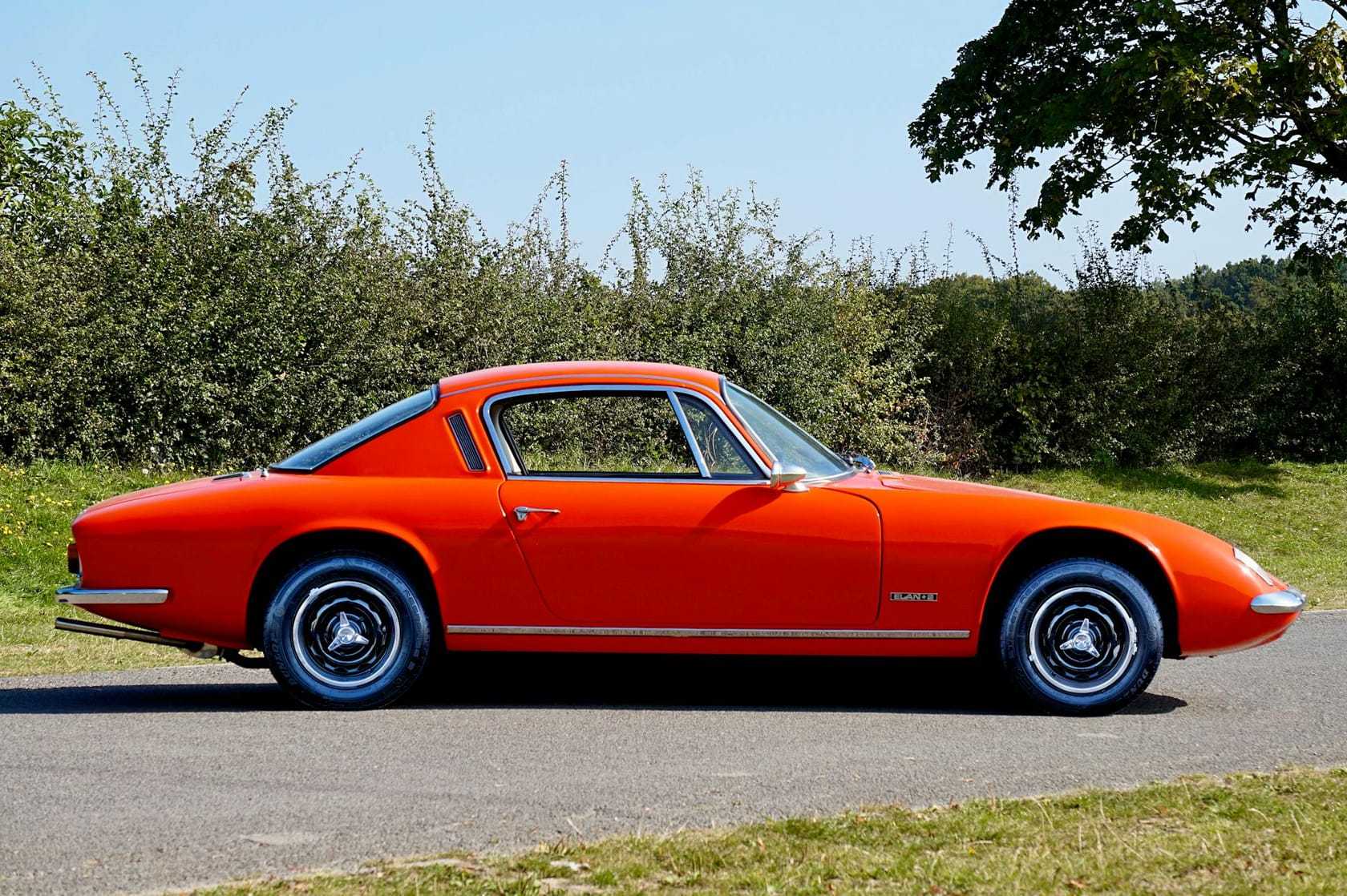
The Elan of 1962 is the heart of the Lotus story: a steel backbone chassis, a glassfibre body, the twin-cam engine and barely 700 kilograms, adding up to handling that made every contemporary sports car feel antique. It ran until 1973 alongside the stretched +2 and the mid-engined Europa, and its DNA reappeared everywhere from the Elise to the original Mazda MX-5, whose engineers openly benchmarked it. For most enthusiasts the Elan simply is Lotus.
The same twin-cam era produced the great collaboration: the Lotus Cortina of 1963, Ford’s family saloon rebuilt at Cheshunt with the twin-cam engine, lowered suspension and the famous green side flash, which won the British touring-car title in Jim Clark’s hands and put the Lotus name in front of buyers who would never see an Elan. The Mk2 of 1967 moved production to Ford but kept the recipe, and both generations are prized today, the definitive proof of how far Chapman’s engine and reputation travelled beyond his own factory.

Growing up: Esprit, Eclat and Excel
The 1970s brought the move upmarket. The Esprit of 1976 wore Giugiaro’s fold-crease wedge over a backbone chassis and became a global icon the moment it drove underwater in a Bond film, maturing through turbocharging into a genuine supercar rival. Beside it sat the practical wedges, the Elite and Eclat four-seaters and their thoroughly developed successor the Excel, built with Toyota components through a partnership that steadied the company through hard times. The Excel remains the most underrated car Hethel ever made.

The outrageous postscript: Lotus Carlton
In 1990 Lotus applied the philosophy to someone else’s car and produced the most controversial saloon Britain ever sold. The Lotus Carlton, a Vauxhall rebuilt around a twin-turbo straight-six, out-ran contemporary Ferraris with five seats and a boot, provoked questions in Parliament and calls for a ban, and then vanished after fewer than a thousand were built. It has become the definitive fast-saloon legend.

Buying and owning a classic Lotus
Every classic Lotus shares the same basic anatomy, glassfibre body over a steel backbone or frame, so the inspection priorities are identical: chassis condition first, especially where the Elan and Esprit backbones rust at the front crossmember and around mounting points, then the body’s gel coat and crazing, then the health of model-specific systems, twin-cam water pumps, Esprit cooling pipes, Excel electrics. Specialist support is excellent for so small a marque, club knowledge runs deep, values reward the best cars, and everything up to the early Esprits now qualifies under the forty year rule. None is a car to buy casually; all are cars to buy deliberately.