From a Thames pump works to Luton
Vauxhall is older than the motor car. Alexander Wilson founded his engineering works on the Thames at Vauxhall in 1857 to build pumps and marine engines, and the firm turned out its first car in 1903, a single-cylinder runabout steered by tiller. Two years later carmaking moved north to Luton, where it has remained through every change of fortune since, and the badge came from the old district itself: the griffin of Falkes de Breauté, the medieval soldier whose “Fulk’s Hall” wore down over the centuries into the word Vauxhall.

Vauxhall at auction
What a classic Vauxhall sells for at auction
- Median sale, 2025
- £6,200 Up from £5,269 in 2021
- Sales in 2025
- 43 The most we have recorded in a year
- Sold when offered
- 72.9% Of the cars put up for auction since 2004
- The record
- £1.2m 30-98, Gooding & Co, September 2020
The sporting years: Prince Henry and the 30-98
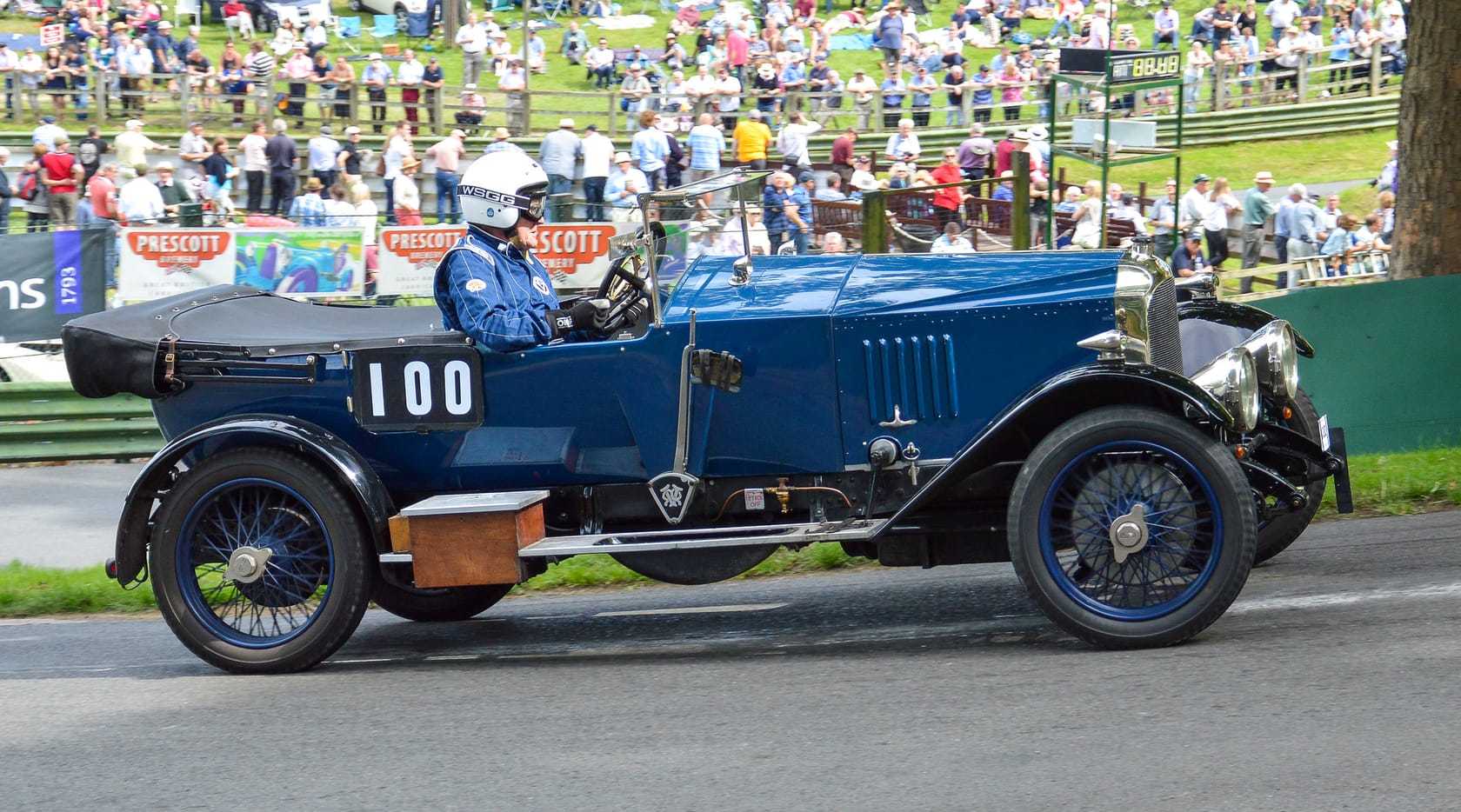
The company GM bought was not a maker of sensible saloons. Edwardian Vauxhall built some of the finest sporting cars in the world: the 1911 Prince Henry carries one of the strongest claims to being the first true sports car, and its successor the 30-98 was the great British fast car of the vintage era, the machine a gentleman raced against Bentleys. That bloodline ended in 1925 when General Motors bought the company, its first great overseas acquisition, and pointed Luton at the volume market instead. Enthusiasts have argued about the trade ever since; the company survived a century on the strength of it.

The GM decades: Wyverns, Crestas and the Victor
Post-war Vauxhall settled into its role as Britain’s other everyman marque, the perpetual third force behind Ford and the BMC combine. The Vauxhall Wyvern, the Veloxes and the finned Crestas (the PB Cresta of 1962 the largest of them) brought Detroit’s styling moods to British high streets, and in 1957 the Victor arrived, as American-looking as anything Britain ever mass-produced and, for a period, one of the country’s biggest export earners. The Victor ran through five generations to 1976, its story tracking the industry’s own from chrome-age optimism to fleet-market pragmatism. Bedford, Vauxhall’s commercial arm, put the CF van on every high street in the same years.

Chevette, Ellesmere Port and the modern era
The 1960s added the Viva and a second home at Ellesmere Port, followed by the Viva-based Vauxhall Firenza coupe (whose “droop-snoot” HP version pioneered the aerodynamic nose in Britain) and the six-cylinder Vauxhall Ventora. In 1975 came the car that showed the company’s future: the Chevette, a friendly, sharp-nosed hatchback that beat Ford’s Fiesta to the British supermini market by two years and out-sold almost everything its size for a spell. The Vauxhall Carlton kept a big-saloon flag flying through the 1980s, the last of them assembled at Luton, its 176 mph Lotus-built extreme covered in our Lotus Carlton guide. From there the Vauxhall story becomes the Cavalier-and-Astra story, its hot-hatch chapter told on our Astra GTE page, increasingly shared with Opel, though two of its chapters have since crossed into classic territory: the Cavalier itself, whose fleet-era survivors now draw show crowds, and the Vauxhall Calibra of 1989–97, the Cavalier-based coupe that launched as the most aerodynamic production car in the world and, in turbocharged four-wheel-drive form, gave the nineties Vauxhall showroom its poster car. The HS-era Chevette’s rally exploits, meanwhile, deserve their footnote in any telling.

Owning a classic Vauxhall
The GM-era Vauxhalls covered here make undemanding classics: simple pushrod engines, cheap mechanical parts through the enthusiast network, and club scenes that are small, devoted and welcoming. The enemy is the traditional one, rust, which claimed these cars young and makes surviving examples scarcer than their production numbers suggest; body and trim parts are the true hunt. Values stay modest, which keeps the marque one of the friendliest entries into classic ownership; most survivors are old enough for historic vehicle status too, and both our model guides carry the detailed buying checks. The wider practical groundwork lives in owning a classic car, and the cars’ decades in Britain’s classic cars by decade.

The Vauxhall heritage today
For a marque that built cars in the millions, classic Vauxhall history survives in surprisingly concentrated pockets. The company maintains its own heritage fleet at Luton, the enthusiast clubs gather the marques’ survivors at an annual rally that ranks among Britain’s larger single-marque events, and the sporting Edwardians remain fixtures at Prescott and the vintage meetings, where a 30-98 in full cry makes the strongest possible argument for the badge’s credentials. The volume cars are the scarce ones: rust and banger-era attrition mean a Victor or Cresta now draws a bigger crowd at a show than many exotics, simply because nobody has seen one for years.