British classic cars vs the stock market: what 25 years of auction prices show
We measured every British classic that sold often enough at auction to compare fairly, against gold, cash and the FTSE 100. Almost all of them rose in pounds. Barely half rose in value.
621,935 auction results 51 auction houses Covers 1997–2025 65 models measured
Ask a room of enthusiasts whether classic cars have been a good investment and most hands go up. The evidence for that belief is usually a story: the E-Type bought for £4,000 in 1985, the Healey that “went up every year”. We wanted to know what the whole market did, not its best anecdotes, so we measured it.
This study takes 621,935 auction results from 51 auction houses, finds every British classic that sold often enough in both the late 1990s and the last five years to be compared fairly, and asks one question of each: after inflation, is the typical example worth more or less than it was 22 years ago? It then asks the same question, in exactly the same way, of gold, of cash left in the bank, and of the stock market: the FTSE 100 with and without its dividends.
The short version: almost every classic went up in pounds, barely half went up in purchasing power, and as a group they lost to a cheap index fund by a wide margin. A handful of cars did better than any of the benchmarks except gold. Nothing beat gold.
Classics against gold, shares and cash
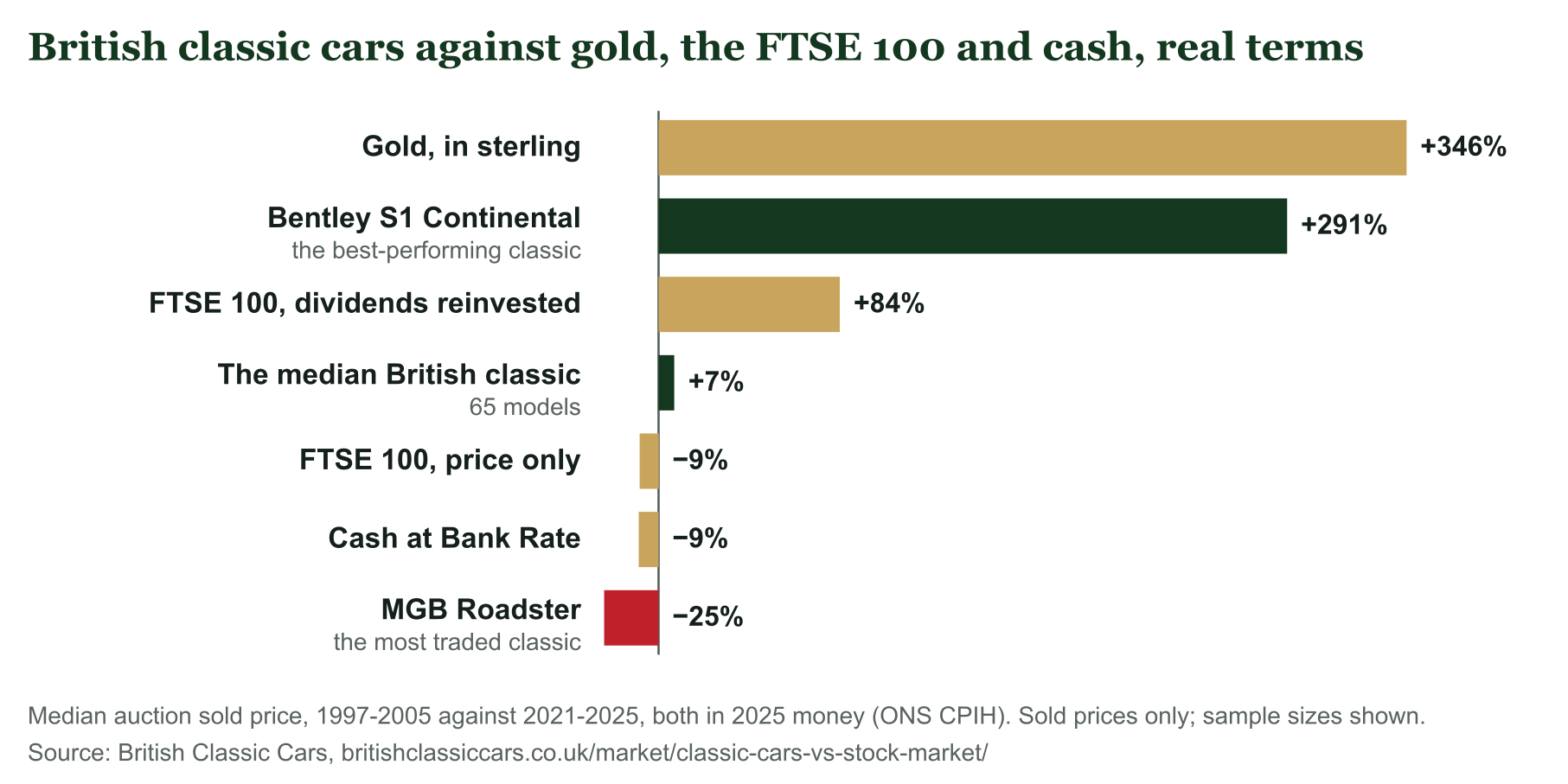
The fair way to compare a car with an index is to treat them identically. For each we took the median level across 1997 to 2005, the median across 2021 to 2025, restated both in 2025 money, and looked at the change. The midpoint gap is 22 years.
- Classic cars
- Benchmarks
- Gold, in sterling+346%
- Bentley S1 Continental the best-performing classic+291%
- FTSE 100, dividends reinvested+84%
- The median British classic the midpoint of all 65 models+7%
- FTSE 100, price only−9%
- Cash at Bank Rate−9%
- MGB Roadster the most traded classic−25%
Three things stand out.
The first is how ordinary the typical classic’s performance was. The median British classic gained 7% in real terms over 22 years. That is about a third of one percent a year. It beat cash at Bank Rate, which lost 9% of its purchasing power, and it beat the FTSE 100 as a bare price index, which also lost 9%. It did not come close to the FTSE 100 once dividends are reinvested, which is how anyone holding a tracker would have held it: that made 84%.
The second is how few cars cleared the tracker. Twelve of the 65 did, and the count is not sensitive to the dividend assumption the method box explains: between ten and fourteen whichever reasonable yield you pick. Put another way, if you had chosen a British classic at random at the turn of the century, you had roughly a one-in-five chance of beating a SIPP, and you paid to store it for two decades.
The third is gold. It rose 346% in sterling after inflation. The best-performing car in the study, the Bentley S1 Continental, made 291%. The second best with a solid record, the Aston Martin DB6, made 131%. Nothing with wheels kept up with bullion, which says more about gold’s 22 years than about cars, but it is the comparison the “classics as an asset class” pieces never make.
The cars that did beat the market
- Bentley S1 Continental £90k to £351k, from 9 and 10 sales+291%
- Aston Martin DB6 £84k to £193k, from 8 and 60 sales+131%
- Jaguar E-Type Series 1 3.8 Roadster £58k to £133k, from 13 and 138 sales+130%
- Aston Martin V8 saloon (Series II to IV) £28k to £60k, from 10 and 128 sales+113%
- Jaguar E-Type Series 1 4.2 Roadster £53k to £111k, from 10 and 163 sales+110%
- Jaguar E-Type Series 3 Coupe £19k to £40k, from 11 and 149 sales+108%
- Rolls-Royce Phantom III £50k to £94k, from 9 and 12 sales+88%
- Jaguar E-Type Series 2 Roadster £40k to £64k, from 27 and 209 sales+59%
- Jaguar E-Type Series 3 Roadster £43k to £69k, from 26 and 250 sales+58%
- Triumph TR6 £11k to £17k, from 11 and 695 sales+53%
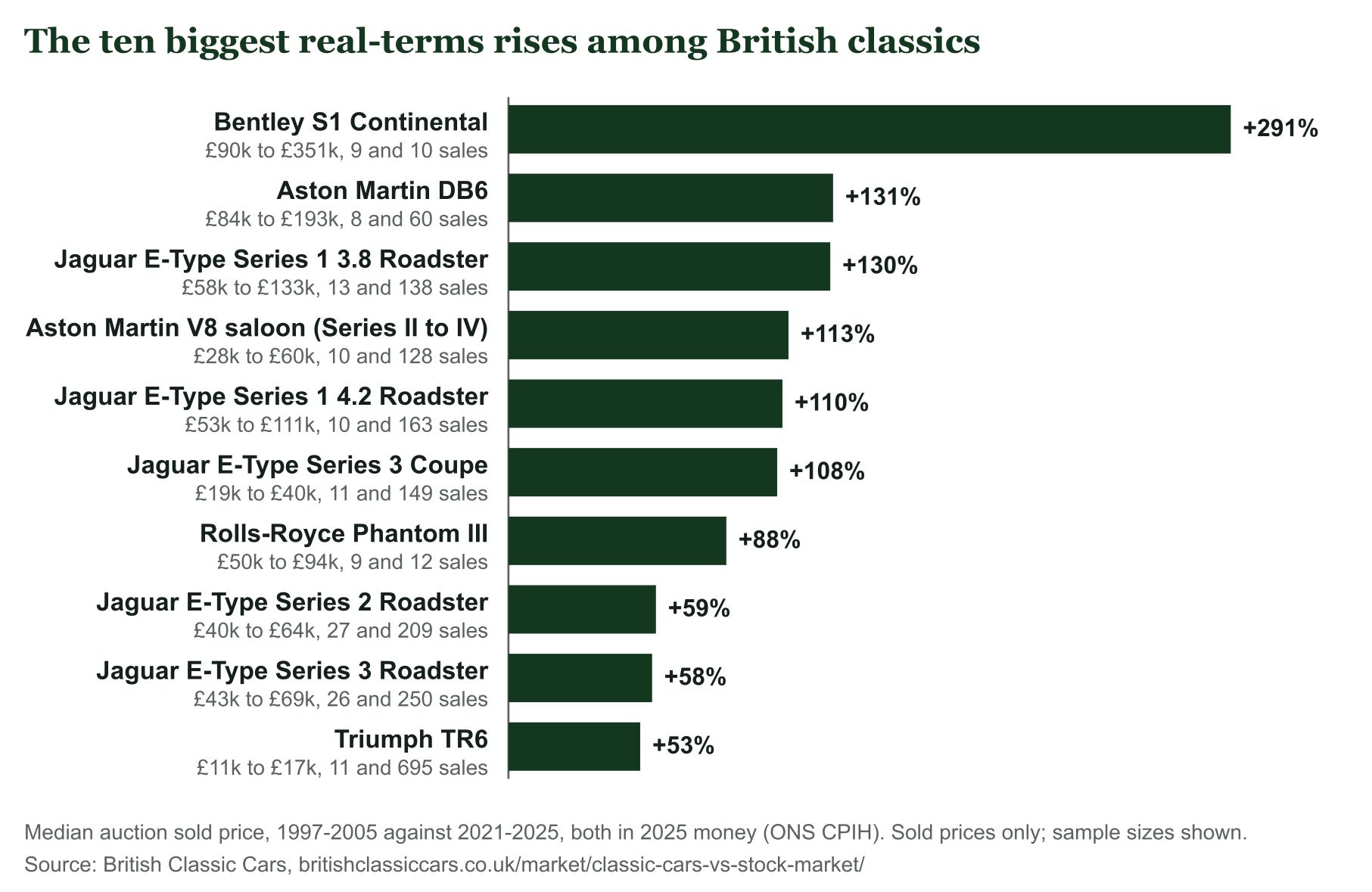
The winners’ list is a short lesson in what the market has rewarded since 1997: coachbuilt grand tourers, the E-Type, and the V8 Astons.
The S1 Continental leads by a distance. Its median sold price moved from £90,000 in today’s money to £351,000, on nine early sales and ten recent ones. That is a thin market, and we checked the recent results against the auction houses’ own published figures before letting it lead anything: a 1957 sports saloon at £330,000 in December 2022, a 1956 fastback at £316,250 at the 2023 Revival sale, a 1956 fastback at £374,650 with premium in February 2021. They are real, and they are typical of the sample rather than its top.
The DB6 more than doubled, from £84,000 to £193,000, and it did so as the sensible Aston, the car bought by people priced out of the DB5. The carburettor V8 saloon of the 1970s and 80s, long the cheap way into the marque, did almost as well in percentage terms, £28,000 to £60,000, on 128 recent sales.
Then the E-Type, which did what people assume every classic does. The Series 1 3.8 roadster went from £58,000 to £133,000, the 4.2 roadster from £53,000 to £111,000, and even the Series 3 coupe, the V12 car the market long treated as the lesser E-Type, doubled from £19,000 to £40,000. Five E-Type variants sit in the top ten; we show them separately because they are separately traded and separately priced, and because their spread (the Series 2 and Series 3 roadsters made 59% and 58%) is itself a finding about where the money went within one model.
The other entries are the Phantom III, the V12 Rolls-Royce of the late 1930s, up 88% while every smaller pre-war Rolls-Royce fell, and the TR6, the one mass-market sports car in the top ten at +53%, on 695 recent sales.
One car rose further than any of them and is not on the chart. The Reliant Scimitar GTE went from a median of £1,330 to £4,503, +238% in real terms. It is a true story about a car that was nearly worthless and is now merely cheap, but six early sales is not a basis we would put on a headline, so it lives in the full ranking with the others marked as thin.
The cars that lost to inflation
- Rolls-Royce 20hp £49k to £31k, from 10 and 28 sales−36%
- Rolls-Royce 25/30 £40k to £26k, from 8 and 15 sales−35%
- Rolls-Royce 20/25 £51k to £34k, from 15 and 49 sales−33%
- MG TC Midget £32k to £23k, from 8 and 141 sales−29%
- MGB Roadster £11k to £7,901, from 25 and 930 sales−25%
- MG TF Midget (1953-55) £26k to £20k, from 8 and 156 sales−21%
- Rolls-Royce Silver Shadow I £13k to £11k, from 24 and 200 sales−19%
- Austin-Healey 3000 Mk III (BJ8) £54k to £45k, from 30 and 219 sales−16%
- Austin-Healey 3000 Mk I £41k to £35k, from 10 and 16 sales−16%
- Austin Seven £8,798 to £7,697, from 11 and 112 sales−13%
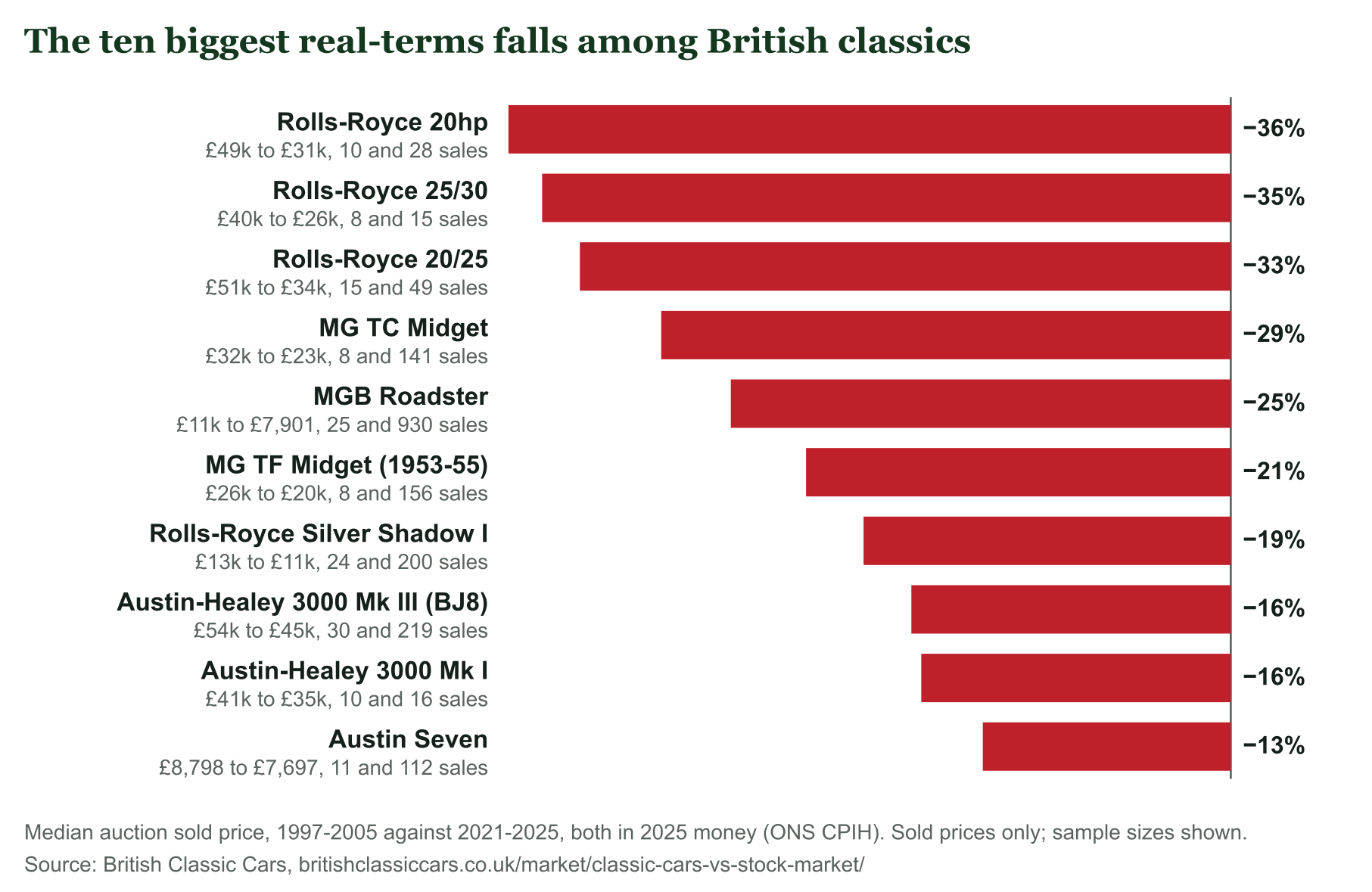
This is the list that will surprise people, because most of the cars on it are the ones everyone calls safe.
The MGB roadster is the most traded classic car in the world, and the most documented row in this study: 25 early sales, 930 recent ones. Its median moved from £10,600 to £7,900 in today’s money, a fall of 25%. In cash terms it rose 16%, which is why owners have not noticed. An MGB bought in 2000 and sold in 2024 gave back the pounds you put in with a sixth on top, and inflation took a quarter of the purchasing power.
The big Healeys tell the same story with bigger numbers. The 3000 Mk III, on 30 early sales and 219 recent ones, fell 16% in real terms from £54,000 to £45,000. The Mk I fell a similar amount. These are not cars that have gone out of fashion; they are cars whose prices stopped rising around the time their buyers stopped getting younger.
The sharpest falls among well-documented models are the small pre-war Rolls-Royces: the 20/25 fell 33%, the 25/30 35% and the 20hp 36%. Set that against the Phantom III in the winners’ list and a pattern appears that runs through the whole table. The buyers who wanted a 20/25 in 2000 were people who remembered them on the road, and they are leaving the market. The grandest car of the same era, the one a younger collector buys for what it represents rather than what they remember, rose 88%. The same split shows in the MG T-series (the TC down 29%, the TF down 21%) against the Series 1 E-Type, and in the Silver Shadow I, down 19% on 200 recent sales, against the Corniche, up 34%.
Cash terms soften all of this. Of the 28 models that fell in real terms, 25 still rose in pounds. Only three, the Bentley R-Type, the Phantom V and the Silver Dawn, are worth fewer pounds than they were at the turn of the century, and all three are on thin early samples.
The full ranking
Every British classic with at least five sales in both windows, 65 models, best real-terms change first. Model names link to our guides.
| # | Model | Median 1997-05 | Median 2021-25 | Real | Cash | Sales |
|---|---|---|---|---|---|---|
| Gold benchmark | +346% | |||||
| 1 | Bentley S1 Continental | £89,964 | £351,412 | +291% | +555% | 9 / 10 |
| 2 | Reliant Scimitar GTE † | £1,330 | £4,503 | +238% | +460% | 6 / 70 |
| 3 | Aston Martin V8 Volante (Series I) † | £43,857 | £110,620 | +152% | +326% | 5 / 18 |
| 4 | Aston Martin DB6 | £83,648 | £192,853 | +131% | +250% | 8 / 60 |
| 5 | Jaguar E-Type Series 1 3.8 Roadster | £57,963 | £133,003 | +130% | +269% | 13 / 138 |
| 6 | Aston Martin V8 saloon (Series II to IV) | £27,984 | £59,527 | +113% | +242% | 10 / 128 |
| 7 | Jaguar E-Type Series 1 4.2 Roadster | £52,793 | £110,956 | +110% | +226% | 10 / 163 |
| 8 | Jaguar E-Type Series 3 Coupe | £19,457 | £40,497 | +108% | +242% | 11 / 149 |
| 9 | Austin-Healey 100M † | £59,966 | £120,533 | +101% | +232% | 5 / 11 |
| 10 | Aston Martin V8 Vantage Volante † | £84,563 | £165,636 | +96% | +222% | 5 / 9 |
| 11 | Mini Cooper (Austin and Morris) † | £9,578 | £18,562 | +94% | +219% | 7 / 77 |
| 12 | Rolls-Royce Phantom III | £49,888 | £93,633 | +88% | +227% | 9 / 12 |
| FTSE 100, dividends reinvested benchmark | +84% | |||||
| 13 | Mini Cooper S (Austin and Morris) † | £14,436 | £26,448 | +83% | +191% | 5 / 98 |
| 14 | Jaguar XK120 Fixed-Head Coupe † | £37,096 | £65,099 | +76% | +185% | 6 / 48 |
| 15 | Alvis TD21 † | £12,443 | £20,474 | +65% | +136% | 5 / 23 |
| 16 | Jaguar E-Type Series 2 Roadster | £40,286 | £64,190 | +59% | +154% | 27 / 209 |
| 17 | Jaguar E-Type Series 3 Roadster | £43,458 | £68,563 | +58% | +152% | 26 / 250 |
| 18 | Aston Martin V8 Vantage Saloon † | £120,895 | £185,461 | +53% | +144% | 6 / 15 |
| 19 | Triumph TR6 | £11,045 | £16,904 | +53% | +143% | 11 / 695 |
| 20 | Jaguar XK120 Drophead Coupe † | £47,059 | £71,553 | +52% | +147% | 5 / 30 |
| 21 | Austin-Healey 3000 Mk II | £30,308 | £45,665 | +51% | +120% | 13 / 22 |
| 22 | Sunbeam Alpine (1959-68) † | £6,985 | £10,380 | +49% | +149% | 6 / 111 |
| 23 | Bentley 4¼ Litre | £45,587 | £65,677 | +44% | +144% | 10 / 23 |
| 24 | Rolls-Royce Corniche I | £30,360 | £40,722 | +34% | +128% | 14 / 107 |
| 25 | Jaguar Mk 2 3.4 † | £14,967 | £19,040 | +27% | +113% | 7 / 83 |
| 26 | Rolls-Royce Phantom II | £86,728 | £109,831 | +27% | +107% | 15 / 35 |
| 27 | Rolls-Royce Phantom I | £74,993 | £93,215 | +24% | +97% | 10 / 46 |
| 28 | Morgan Plus 4 † | £20,990 | £24,789 | +18% | +93% | 6 / 130 |
| 29 | Jaguar XJ6 (Series 1 to 3) | £5,573 | £6,509 | +17% | +88% | 20 / 299 |
| 30 | Jaguar XK140 Drophead Coupe † | £78,268 | £87,886 | +12% | +82% | 5 / 46 |
| 31 | MG Midget 1500 † | £3,991 | £4,404 | +10% | +82% | 7 / 153 |
| 32 | Bentley Mk VI | £18,550 | £20,174 | +9% | +70% | 14 / 115 |
| 33 | MGA 1600 Roadster † | £19,553 | £20,989 | +7% | +74% | 7 / 120 |
| 34 | Jaguar XK140 Roadster | £73,064 | £77,839 | +7% | +64% | 9 / 69 |
| 35 | MGC Roadster † | £15,813 | £16,837 | +7% | +80% | 6 / 54 |
| 36 | MGB GT | £5,531 | £5,800 | +5% | +71% | 18 / 499 |
| 37 | Jaguar XK120 Roadster | £68,240 | £71,469 | +5% | +72% | 27 / 157 |
| 38 | Austin Mini † | £11,411 | £11,250 | −1% | +60% | 5 / 121 |
| 39 | Bentley 3½ Litre † | £80,421 | £79,109 | −2% | +53% | 6 / 14 |
| 40 | Triumph TR4A † | £21,468 | £21,027 | −2% | +75% | 5 / 117 |
| 41 | MG TD Midget | £16,003 | £15,204 | −5% | +53% | 14 / 299 |
| 42 | Austin-Healey 3000 Mk II (BJ7) † | £37,152 | £35,250 | −5% | +56% | 7 / 61 |
| 43 | Rolls-Royce Silver Wraith | £33,524 | £31,724 | −5% | +59% | 11 / 56 |
| 44 | Rolls-Royce Silver Shadow II | £14,047 | £13,157 | −6% | +52% | 10 / 117 |
| FTSE 100, price only benchmark | −9% | |||||
| Cash at Bank Rate benchmark | −9% | |||||
| 45 | Jaguar Mk 2 3.8 | £26,940 | £24,327 | −10% | +46% | 11 / 164 |
| 46 | Rolls-Royce Silver Cloud II | £28,591 | £25,526 | −11% | +36% | 9 / 43 |
| 47 | Rolls-Royce Silver Cloud III | £46,041 | £40,396 | −12% | +56% | 11 / 74 |
| 48 | Austin Seven | £8,798 | £7,697 | −13% | +43% | 11 / 112 |
| 49 | Humber Super Snipe † | £6,554 | £5,651 | −14% | +39% | 6 / 26 |
| 50 | Austin-Healey 3000 Mk I | £41,157 | £34,718 | −16% | +46% | 10 / 16 |
| 51 | Austin-Healey 3000 Mk III (BJ8) | £54,047 | £45,341 | −16% | +32% | 30 / 219 |
| 52 | Rolls-Royce Silver Shadow I | £13,121 | £10,697 | −19% | +27% | 24 / 200 |
| 53 | MG TF Midget (1953-55) | £25,929 | £20,387 | −21% | +25% | 8 / 156 |
| 54 | MGA 1500 Roadster † | £25,578 | £19,698 | −23% | +28% | 6 / 57 |
| 55 | MGB Roadster | £10,559 | £7,901 | −25% | +16% | 25 / 930 |
| 56 | Austin-Healey 3000 Mk II (BT7) † | £51,771 | £38,063 | −27% | +13% | 5 / 29 |
| 57 | MG TC Midget | £32,153 | £22,910 | −29% | +23% | 8 / 141 |
| 58 | Rolls-Royce 20/25 | £51,056 | £34,332 | −33% | +10% | 15 / 49 |
| 59 | Riley RME † | £10,950 | £7,243 | −34% | +11% | 5 / 15 |
| 60 | Rolls-Royce 25/30 | £40,224 | £26,261 | −35% | +0% | 8 / 15 |
| 61 | MG PA Midget † | £37,532 | £24,453 | −35% | +4% | 5 / 12 |
| 62 | Rolls-Royce 20hp | £49,444 | £31,422 | −36% | +6% | 10 / 28 |
| 63 | Bentley R-Type † | £38,839 | £23,331 | −40% | −0% | 6 / 72 |
| 64 | Rolls-Royce Phantom V † | £89,883 | £47,201 | −48% | −19% | 7 / 23 |
| 65 | Rolls-Royce Silver Dawn † | £90,046 | £25,297 | −72% | −54% | 5 / 42 |
Gold rows are the benchmarks, sitting at the rank they would hold among the cars: everything above a benchmark line beat it. Both medians are in 2025 money; "Real" is the change between them, "Cash" the change before inflation; "Sales" is the number of sold results in the early and late windows. The rule under each real-terms figure is drawn to the same scale throughout, so any two can be compared by eye. † marks the 29 models with fewer than 8 early-window sales: included for completeness, kept out of the headline charts.
How often a classic actually comes up for sale
Price guides tell you what a car is worth. None of them tells you how long you will wait for one to be offered, which for anything rarer than an MGB is the question that decides whether you can buy at all. We counted.
- No sale Aston Martin 1.5 Litre
- No sale Alvis Speed 20 SB
- One in five years Bentley R-Type Continental (H.J. Mulliner)
- One in five years Aston Martin DB6 Vantage Volante
- One in five years Rolls-Royce Phantom I Barker
- One in five years Aston Martin V8 Zagato Volante
- One in five years Bentley S2 Continental (H.J. Mulliner)
- One in five years Lagonda LG6
- One in five years Aston Martin 15/98
- One in five years Jaguar XK150 3.4 SE Drophead Coupe
Worldwide auction sales across the 1,908 British models in the data. The rare list is limited to cars with a median above £40,000 and at least eight sales on record, so a thin label does not pass as a rare car.
An MGB roadster sells at auction somewhere in the world every other day, 186 a year across 2021 to 2025. A TR6 sells every two or three days, a Defender 110 every three or four. For these cars there is always another one, and the first rule of buying one, never stretch for a bad example, costs nothing to follow.
At the other end, money cannot hurry anything. The Aston Martin 1.5 Litre and the Alvis Speed 20 SB, both cars with a dozen or more sales on record and six-figure medians, recorded no auction sale at all in five years. The H.J. Mulliner R-Type Continental, median £826,000, comes up about once every five years. Across the 1,908 British models in the data, 22 established cars had no sale in the period and another 674 trade less than once a year. Those are worldwide counts; a buyer who wants a right-hand-drive car sold in Britain waits longer still.
One more number no price guide publishes: across the British cars in the data, roughly three in four offered at auction actually sell. The other quarter go home, which is worth remembering when an estimate looks confident.
What this means if you are buying
None of this says do not buy a classic. It says buy one for the right reason. Over 22 years the typical British classic roughly held its value after inflation, which for an object you can drive, show and enjoy is a remarkable thing: the same money spent on a new car would have gone to nearly nothing. What it did not do, with a dozen exceptions, is compete with a pension fund, and it was never going to once storage, insurance and maintenance are counted, which this study does not.
If you want the car that has done best as a store of value, the ranking is clear: the coachbuilt Bentleys, the DB Astons, the early E-Types and the grand pre-war Rolls-Royces. If you want the car that is easiest to buy and sell, it is the MGB, and you should expect it to return your pounds rather than multiply them. Our guide to buying a classic at auction covers the mechanics; the model guides linked in the table carry each car’s own sold-price record, updated with every refresh of the data.
Twelve findings you can quote
Every finding below has its own web address: hover or tab to a heading and click the # beside it to link straight to that one. The method box explains how each figure was measured, and the sample sizes behind them are in the full ranking.
Most classics rose in pounds, barely half rose in valueLink to this finding
62 of 65 British classics (95%) rose in cash terms between 1997 to 2005 and 2021 to 2025. After inflation, 37 (57%) rose and 28 fell. The median real-terms change was +7%, about 0.3% a year.
Gold beat every British classicLink to this finding
Gold in sterling rose 346% in real terms. The best-performing British classic, the Bentley S1 Continental, rose 291%. No car in the study kept up with bullion.
Twelve of 65 beat a FTSE 100 trackerLink to this finding
With dividends reinvested, the FTSE 100 made 84% in real terms. Twelve British classics beat it. Between ten and fourteen do across any reasonable dividend assumption.
But the median classic beat cash and the bare indexLink to this finding
Cash at Bank Rate lost 9% of its purchasing power over the period. The FTSE 100 as a price index also lost 9%. The median classic, at +7%, beat both.
The S1 Continental is the best performerLink to this finding
Median sold price from £90,000 to £351,000 in 2025 money, +291%, on nine early and ten recent sales, each recent result checked against the auction house’s published figure.
The E-Type did what people think every classic doesLink to this finding
Series 1 3.8 roadster +130% (£58,000 to £133,000); Series 1 4.2 roadster +110%; Series 3 coupe +108%; Series 2 and Series 3 roadsters +59% and +58%. Five of the top ten are E-Types.
The DB6 outran its own hype cycleLink to this finding
The Aston Martin DB6 rose 131% in real terms, from £84,000 to £193,000, on 60 recent sales. The carburettor V8 saloon rose 113% on 128.
The world’s favourite roadster lost a quarter of its valueLink to this finding
The MGB roadster, the most traded classic in the study (930 recent sales), fell 25% in real terms, from £10,600 to £7,900. It rose 16% in cash.
The generational shift, measuredLink to this finding
The small pre-war Rolls-Royces fell: 20hp -36%, 25/30 -35%, 20/25 -33%. The grandest car of the era, the Phantom III, rose 88%. The same split runs through the MG T-series (down) against the early E-Types (up).
Even the Big Healey lost to inflationLink to this finding
The Austin-Healey 3000 Mk III fell 16% in real terms on 30 early and 219 recent sales. The Silver Shadow I fell 19% on 200 recent sales.
An MGB sells at auction every other dayLink to this finding
186 MGB roadsters a year sold at auction worldwide across 2021 to 2025; 139 TR6s; 108 Defender 110s. Meanwhile 22 established British models recorded no sale at all in five years and 674 trade less than once a year.
Three in four classics offered actually sellLink to this finding
Across the British cars in the data, 73% of lots offered found a buyer. The rest went home unsold.
Frequently asked questions
Are classic cars a good investment?
Have classic car values gone up or down?
Which classic cars have gone up in value the most?
Which classic cars have lost value?
Did classic cars beat gold?
How was this measured?
The cars in this study
Every model below cleared the evidence threshold and has a full guide on this site. The figure is its real-terms change in median auction price between 1997 to 2005 and 2021 to 2025.
Recently added

British car records: the smallest, the fastest, the dearest

Morgan 4/4: the longest-running car name in the world (1936–2018)

Selling a classic car privately: what the law asks of you, what it does not, and how not to get stung
