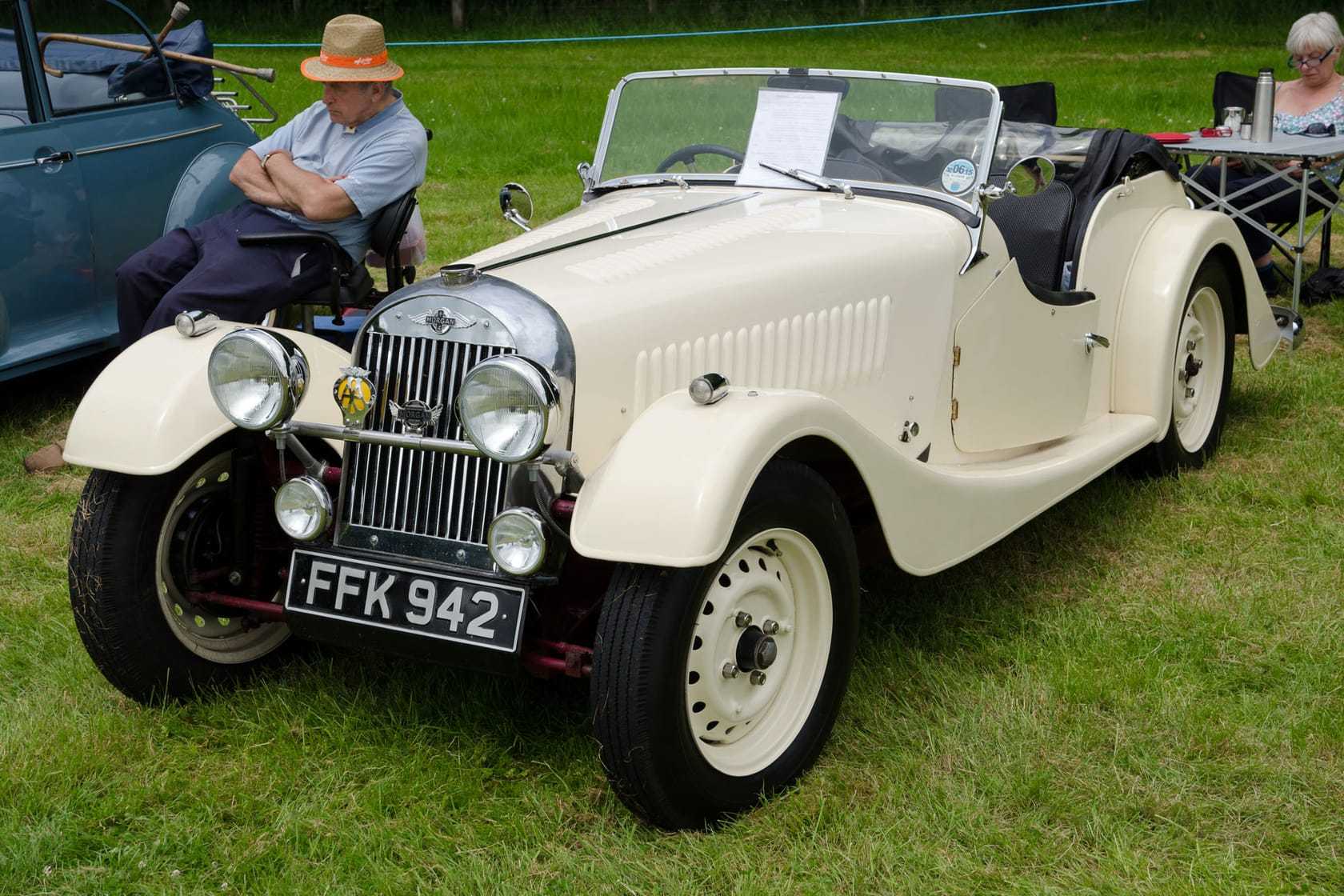
Every other maker on this site modernised, merged or died. Morgan did none of it. From the same Malvern Link works it has occupied since 1919, the Morgan family firm hand-built sports cars on ash frames and sliding-pillar suspension through wars, takeovers it refused and fashions it ignored, and the classic Morgan cars that resulted, the 4/4, the Plus 4 and the Plus 8, offer something nothing else here can: the vintage motoring experience in machines young enough to use every weekend.
Three wheels first: 1910–1952
H.F.S. Morgan’s first car of 1910 had three wheels, a V-twin engine hung out front and the weight of a motorcycle, which made it quick, frugal and taxed as a cyclecar: commercial cunning dressed as sporting purity. The three-wheelers won races, set records and built the firm through the twenties and thirties, their Super Sports models now prized vintage machinery, and the type survived to 1952 (before its celebrated 21st-century revival). The three-wheeler’s DNA, minimal weight over honest power, never left anything Malvern built afterwards.

Morgan at auction
What a classic Morgan sells for at auction
- Median sale, 2025
- £19,675 Down from £23,066 in 2021
- Sales in 2025
- 112 The most we have recorded in a year
- Sold when offered
- 69.1% Of the cars put up for auction since 1994
- The record
- £143k Plus 4, Bonhams, January 2013
Four wheels, four cylinders, eight decades
The 1936 4/4, four wheels and four cylinders, took Morgan into the sports-car mainstream and simply stayed there: the same essential car, ash frame over steel chassis and sliding-pillar front suspension, remained in production until 2018, the longest run of any car nameplate in the world. The 1950 Plus 4 added Standard Vanguard and then Triumph TR power, tying Malvern to the Triumph sports-car story, and in 1968 the Plus 8 dropped the all-alloy Rover V8 into the old chassis to create one of the fastest-accelerating British cars of its day. Each line has its own guide in the index above.
Le Mans, the SLR and racing Malvern
The stubborn old cars kept embarrassing modern ones. The factory’s finest hour came at Le Mans in 1962, when Chris Lawrence’s Plus 4 Super Sports, TOK 258, won the two-litre GT class, and the SLR lightweight coupes that followed gave the Plus 4 a streamlined racing silhouette still campaigned in historic events. Morgans remain fixtures of historic racing and hillclimbing, where the combination of light weight, honest chassis and tunable Triumph and Ford engines keeps them genuinely competitive against far younger designs.

The waiting list and the family firm
Morgan’s other great engineering achievement was commercial: it stayed private, family-owned and small on purpose, building roughly ten cars a week when demand would have supported many times that number. The result was the famous waiting list, years long for decades, which converted scarcity into mystique and kept values firm; the firm politely declined the mergers that consumed the rest of the industry. The company builds on in Malvern today with its modern Plus Four, Plus Six and Super 3, cars outside this site’s classic scope but proof that the promise held.

Owning a classic Morgan
Morgan ownership is better supported than almost any specialist marque: the factory itself supplies parts and heritage records, the Morgan Sports Car Club is among Britain’s most active, and the engines, Ford, Triumph and Rover V8, are the best-served units in the hobby. The buying disciplines are the ash frame (probe for rot at the sills, door posts and wings), chassis condition, and the sliding-pillar front suspension’s appetite for regular lubrication. Across 800-plus measured sales the classic lines hold a £22,600 median with essentially no depreciation, the market’s verdict on eight decades of refusing to change.

More photos