Reliant Scimitar: the sporting estate that invented its own class (1964–1986)
The Reliant Scimitar grew from a handsome Ford-powered glassfibre coupe into the GTE, the car that invented the sporting estate and counted Princess Anne among its most loyal owners. A guide to the Sabre before it, the GT, GTE and GTC, the Middlebridge revival, what to check when buying, and what a Scimitar is worth.
Built 1964–1990 187 recorded sales
At a glance
- Years
- 1964–1986; Middlebridge revival 1988–1990
- Body styles
- Two-door coupe (GT), sporting estate (GTE), convertible (GTC)
- Drivetrain
- Front engine, rear-wheel drive
- Engines
- Ford straight-six 2.6; Ford Essex V6 3.0; Ford 2.8 (GTC and late cars)
- Power
- Around 120 bhp to 138 bhp
- Trim levels
- GT (SE4), GTE (SE5/SE5a), GTE (SE6 series), GTC (SE8)
- Production
- Around 15,000 across all Scimitars
- Assembly
- Tamworth, Staffordshire
- Designer
- Ogle Design (Tom Karen)
- Values
- Usable from around £4,000; good GTEs £6,000-£12,000; the best and Middlebridge cars beyond
- Claim to fame
- The GTE invented the sports-estate class the world later copied
- Royal warrant, informally
- Princess Anne owned a succession of Scimitar GTEs
The models
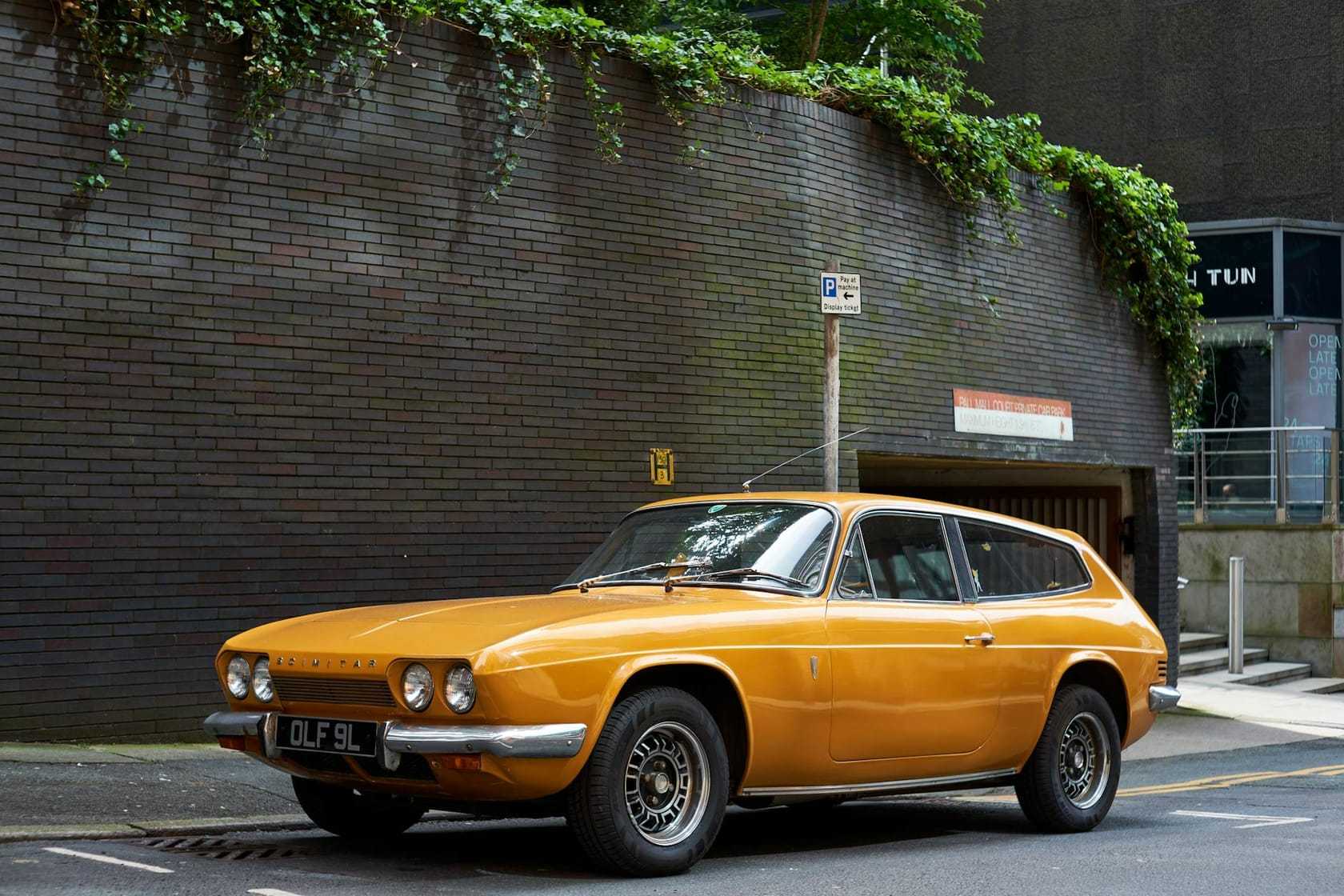
Park a Scimitar GTE beside the sports-estates the premium German brands sell today and you are looking at the original idea. The Reliant Scimitar began in 1964 as a glassfibre grand-touring coupe, but its 1968 GTE version invented the fast estate outright, years before anyone else, and did it from a three-wheeler factory in Tamworth. Add a Ford V6, royal patronage and prices that never caught up with the achievement, and you have one of the great undervalued British classics.
From Sabre to Scimitar
Reliant’s sports-car line started awkwardly in 1961 with the Sabre, a curious-looking roadster developed from an export project, whose early cars raced with more grit than glory. Its worthwhile inheritance was a sound chassis. In 1964 Reliant clothed a developed version of it in a crisp Ogle-designed glassfibre coupe body and named the result Scimitar GT: Ford six-cylinder power, proper GT manners and looks that owed nothing to the three-wheelers paying the bills. The Sabre is now the connoisseur’s rarity; the GT was the foundation.

The GTE: inventing the sporting estate
In 1968 Ogle’s Tom Karen reworked the coupe into something genuinely new: the GTE, a four-seat sporting estate with a rising glass tailgate, a flat load deck and the 3.0-litre Ford Essex V6. It was fast, handsome and useful in a way no rival could match, because there were no rivals; the class did not exist until bigger manufacturers copied it. The GTE became Reliant’s flagship and its best seller, and the SE6 revision of 1975 made it larger and more comfortable still. A convertible GTC followed in 1980, elegant and now rare.
The endorsement money could not buy came from Buckingham Palace: Princess Anne received her first GTE in 1970 and owned a succession of them for decades, occasionally at speeds that made the newspapers. No image-conscious buyer could ask for better proof that the GTE was no joke-company product.

Middlebridge and the long afterlife
GTE production ended in 1986, but the idea refused to die. Middlebridge of Nottingham acquired the rights and from 1988 built a thoroughly updated GTE with Ford’s fuel-injected 2.9 V6; only around eighty cars were completed before funding collapsed in 1990, making Middlebridge Scimitars the rarest and most resolved of the line, and the model the club concours judges measure everything else against. The name returned once more on the smaller SS1 roadster family, a different car for a different decade.

What a Scimitar is like to drive
The GTE’s party trick is how modern it feels. The Essex V6 makes its torque low down, so the car strides rather than strains, overdrive gives long-legged cruising, and the glassfibre body over a stout chassis keeps weight sensible, which means brisk cross-country pace without drama. The driving position is commanding for a sporting car of its era, four adults genuinely fit, and the load bay swallows what a weekend actually requires. It is easy to see why a busy royal kept buying them: the GTE does the fast, useful, unpretentious thing better than almost anything of its decade.
The car’s age shows mostly in the details, heavier low-speed steering on early cars, brakes that want a firm foot, and the usual 1970s ergonomic comedy, and none of it dilutes the essential competence. Later SE6 cars trade a little agility for space and refinement; the earlier SE5 is the sharper drive. Either makes a genuinely usable classic, one of the few of its age that can join a motorway and simply keep up.

Buying a Reliant Scimitar today
The glassfibre body cannot rust, which redirects the inspection underneath. The separate steel chassis rots where mud sits, at the rear spring hangers, outriggers and around the front suspension, and a proper look on ramps is worth more than any amount of shiny gel coat; crazing and star cracks in the glassfibre itself are cosmetic but tedious to put right. The Ford engines are cheap, understressed and endlessly supported; overheating is their one enemy, so check the cooling system. Interiors and Scimitar-specific trim are the scarce items, and electrics reward patience.
Club support is a real asset here: the owners’ community runs spares schemes and remanufactures the scarce items, which keeps a Scimitar on the road more cheaply than its rarity suggests.
Values remain the bargain of the class the car invented: usable GTEs from around £4,000, good ones £6,000 to £12,000, with early GT coupes, the GTC and Middlebridge cars above that. For the money, nothing else Reliant built, and little anyone else built in the 1970s, covers ground with the same blend of pace, space and character. The era’s context lives in the cars of the 1970s.

More photos


The Scimitar in dates
- 1961The awkward Sabre roadster starts the sports-car line; its worthwhile inheritance is a sound chassis.
- 1964The Scimitar GT clothes a developed chassis in Ogle's crisp glassfibre coupe with Ford six-cylinder power.
- 1968Tom Karen's GTE invents the sporting estate: rising glass tailgate, flat load deck and the 3.0 Essex V6, with no rivals because the class did not exist.
- 1970Princess Anne receives her first GTE and owns a succession for decades, occasionally at speeds that make the newspapers.
- 1975The SE6 revision makes the GTE larger and more comfortable; the elegant GTC convertible follows in 1980.
- 1986GTE production ends at around 15,000 Scimitars of all kinds.
- 1988Middlebridge of Nottingham builds around eighty updated fuel-injected cars before funding collapses in 1990, the rarest and most resolved of the line.
Scimitar: what to check before you buy
The chassis, where the money lives
- Rear spring hangers and outriggers, where mud sits
- Around the front suspension
- A proper look on ramps is worth more than any shiny gel coat
- Crazing and star cracks in the glassfibre are cosmetic but tedious to put right
Mechanical
- The Ford engines are cheap and understressed; overheating is their one enemy
- Check the cooling system before anything else mechanical
- Overdrive should engage cleanly and transforms the cruising
- Ford parts networks keep running costs modest
Trim and version
- Interiors and Scimitar-specific trim are the scarce items
- The SE5 is the sharper drive, the SE6 the more spacious tourer
- GT coupes, the GTC and Middlebridge cars sit above the volume GTEs
- The club's spares schemes keep ownership cheaper than the rarity suggests
What the Scimitar GT & GTE sells for at auction
In 2025 the median Scimitar GT & GTE sold for £5,496 across 30 sales, 21% up on 2024. In real terms, typical Scimitar GT & GTE prices were up about 19% over the five years to 2025, once inflation is accounted for.
| Variant | Sold | Typical range | Median |
|---|---|---|---|
| Scimitar GTE | 116 | £1,775 - £6,113 | £3,450 |
| Scimitar | 31 | £1,935 - £8,014 | £4,500 |
| Scimitar GTC | 27 | £4,536 - £8,155 | £6,000 |
| Scimitar GT | 13 | £5,625 - £12,750 | £7,616 |
Show the year-by-year mediansHide the year-by-year medians
| Year | Sold | Median | In 2025 money |
|---|---|---|---|
| 2026 (so far) | 10 | £3,226 | |
| 2025 | 30 | £5,496 | £5,496 |
| 2024 | 21 | £4,536 | £4,710 |
| 2023 | 18 | £4,266 | £4,578 |
| 2022 | 17 | £7,344 | £8,411 |
| 2021 | 19 | £4,301 | £5,318 |
| 2020 | 7 | £3,650 | £4,625 |
| 2019 | 18 | £5,956 | £7,625 |
| 2018 | 14 | £3,562 | £4,637 |
| 2017 | 4 | £4,468 | £5,951 |
| 2016 | 8 | £2,400 | £3,279 |
| 2015 | 5 | £5,800 | £8,004 |
| 2008 | 3 | £1,250 | £2,001 |
| 2005 | 5 | £731 | £1,271 |
- £2,500Scimitar GTE
- £3,400Scimitar GTE
- £1,853Scimitar
- £2,968Scimitar GTE
- £3,052Scimitar
Reasonable evidence. 187 recorded sales: enough for the range to mean something, though a few unusual cars can still move a single year's median. Based on 187 sold results from public classic car auctions (2004 to 10 August 2026). Sold prices, not asking prices, and not a valuation: condition, history and specification vary from car to car. Inflation-adjusted figures use the ONS CPIH index, in 2025 money.
Frequently asked questions
Why is the Reliant Scimitar GTE famous?
Did Princess Anne really drive a Reliant Scimitar?
What engine does a Reliant Scimitar have?
What is a Middlebridge Scimitar?
How much is a Reliant Scimitar worth?
What is the most expensive Scimitar GT & GTE ever sold at auction?
How often does a Scimitar GT & GTE come up for sale?
Related across themes
More from Reliant

Reliant Robin: Britain's most famous three-wheeler, and most misunderstood car (1973–2002)

Reliant Regal: the three-wheeler that carried Britain's tradesmen, and the Trotters (1953–1973)

Reliant Scimitar SS1: Michelotti's last roadster and the bargain of the 1980s (1984–1995)

Reliant Fox: the glassfibre farmhand that came home from Greece (1983–1990)
Recently added

British car records: the smallest, the fastest, the dearest

Morgan 4/4: the longest-running car name in the world (1936–2018)

Selling a classic car privately: what the law asks of you, what it does not, and how not to get stung
