Reliant Regal: the three-wheeler that carried Britain's tradesmen, and the Trotters (1953–1973)
The Reliant Regal put post-war Britain's motorcyclists and tradesmen on three weather-proof wheels, and its Supervan became the most famous van in the country in Only Fools and Horses. A guide to the Regal's twenty years, the alloy-engined 3/25 and 3/30, the Supervan and the television fame, what to check, and what a Regal costs.
Built 1953–1973 17 recorded sales
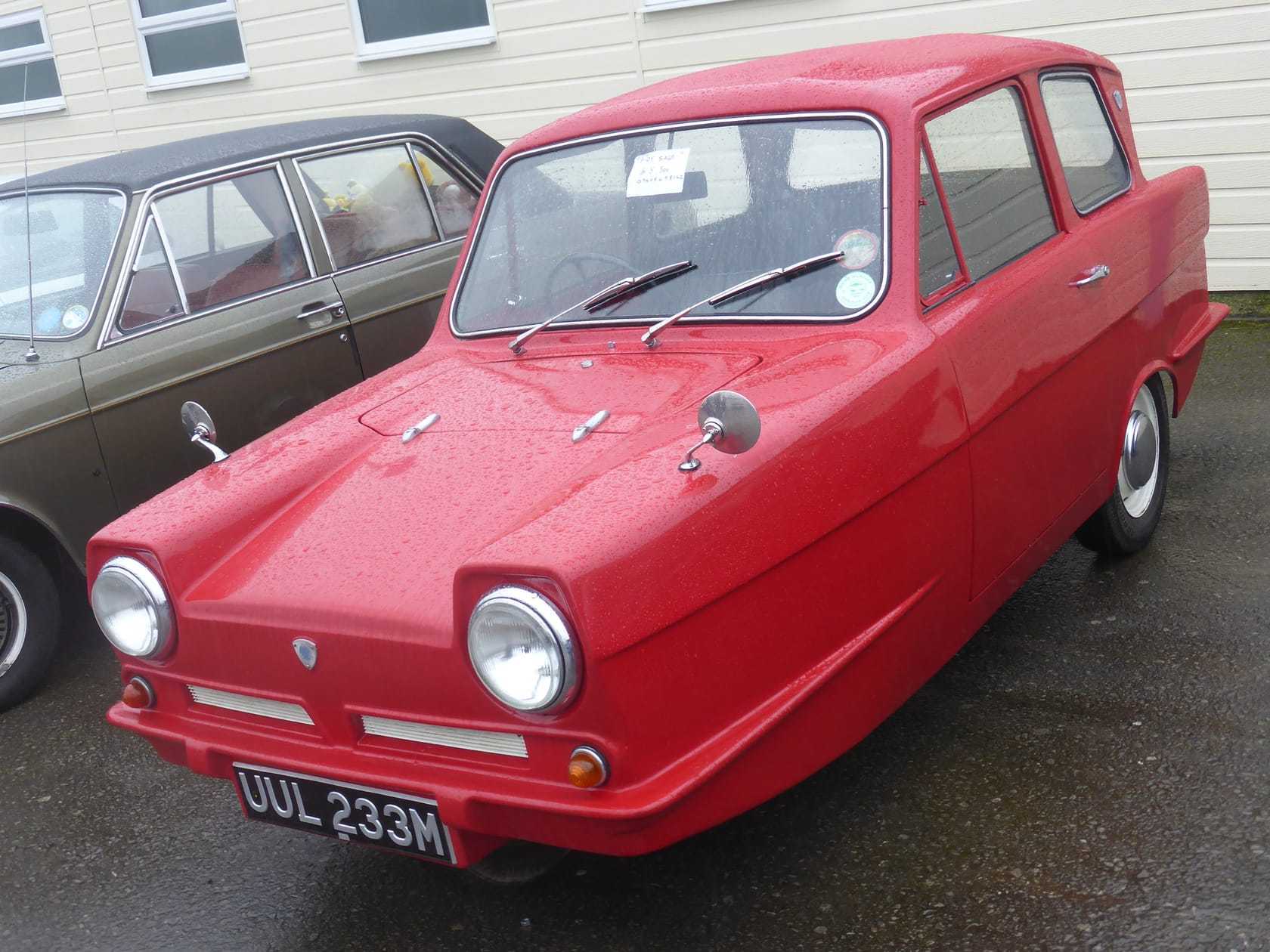
At a glance
- Years
- 1953–1973
- Body styles
- Three-wheeled saloon, coupe and Supervan
- Drivetrain
- Front engine, rear-wheel drive, single front wheel
- Engines
- 747cc sidevalve four; from 1962 Reliant's all-aluminium 598cc, later 700cc
- Power
- Around 16 bhp to 29 bhp
- Trim levels
- Mk I-VI; Regal 3/25; Regal 3/30; Supervan I-III
- Production
- Over 100,000 across the Regal era
- Assembly
- Tamworth, Staffordshire
- Designer
- Reliant; glassfibre bodywork from the mid-1950s
- Values
- Usable from around £3,000; good cars £4,500-£8,000; famous-liveried Supervans beyond
- Television fame
- The Trotters' yellow van is a Regal Supervan III
- Engineering first
- Carried Reliant's pioneering all-aluminium engine from 1962
The models
Del Boy chose it, half of Britain laughed at it, and post-war tradesmen swore by it. The Reliant Regal was the three-wheeler that built Reliant into a real car company: twenty years, several generations and over a hundred thousand vehicles that gave motorcyclists and small traders a dry, car-shaped life on tricycle running costs. Then a sitcom made its van immortal.
Three wheels for austerity Britain
The Regal arrived in 1953 into a Britain where a car was still a luxury and a motorcycle licence was common currency. Taxed as a tricycle and drivable, historically, on that motorcycle licence, the Regal offered shelter, a bench for the family and space for tools at a price and running cost no car could touch. Early cars used a 747cc sidevalve four whose design traced back to the Austin Seven; bodies moved from ash-framed aluminium to glassfibre during the 1950s as Reliant became one of Britain’s pioneers of the material.

The alloy-engine years: 3/25 and 3/30
The Regal grew up in 1962. The new 3/25 carried Reliant’s own all-aluminium 598cc engine, among the first mass-produced alloy engines in Britain and a genuinely advanced unit for a budget three-wheeler, under sharper glassfibre bodywork with a distinctive reverse-rake rear window on the saloon. The 3/30 brought a 700cc version. These are the definitive Regals: nippy enough for main roads, cheap as ever to run, and the direct mechanical ancestors of the Robin that replaced the line in 1973.

The Supervan, Peckham’s finest
The van version, the Supervan, was the working Regal, and the Supervan III became a British icon in yellow. As Trotters Independent Trading’s transport in Only Fools and Horses, and separately as the blue tormentor in Mr. Bean, the Supervan out-famed every car Reliant ever built, while being endlessly misidentified as a Robin. The fame is now part of the market: Supervans lead Regal values, Trotter replicas are a cottage industry, and no British comedy prop is more instantly recognised.
The joke lands because the casting was honest. A Supervan really was what a Peckham market trader would have run in the 1970s and 1980s, cheap to buy, cheap to tax, and immune to rust if not to ridicule, and the series’ screen vans were simply bought used like anyone else’s. Several survivors with claimed screen history have crossed the auction block over the years, fetching the kind of money that would have astonished the original owners, and every one that sells pulls ordinary Supervan values up a little further behind it.

Which Regal to buy
The generations offer genuinely different cars. The early Marks of the 1950s, with their sidevalve engines and coachbuilt origins, are the antiquarian’s choice: slow, charming and rare, best suited to shows and short runs, with the drophead versions the prettiest of all Regals. The 3/25 and 3/30 of the 1960s are the usable pick, their alloy engines happy in modern town traffic and their parts supply the best of the family, and the last 21E cars of the early 1970s added the nicest trim of the run.
Vans carry their own market. The Supervan’s television fame means a sound one now outprices the equivalent saloon comfortably, and Trotter-liveried examples trade on the joke with pride; purists hunt the unrestored originals in period commercial liveries, rarer now than the replicas. Prices reward patience over urgency in this market. Whichever body you choose, the golden rule of tiny production survivors applies: buy the most complete example you can find, because a missing bumper or windscreen surround can take years to source, and a project missing its identity can be a project forever.

Buying a Reliant Regal today
Regal survival ran the gauntlet of hard use, so completeness is the first check: trim, glass, badges and the correct engine matter, because remanufacture is a club-and-barn-find economy rather than a catalogue one. The glassfibre body cannot rust but the chassis beneath can, and does, where mud sat through working winters; kingpins, brakes and electrics want careful eyes. The alloy engines are willing and simple, happiest with clean coolant, fresh oil and a sympathetic right foot. Nothing about a Regal is costly to fix; the challenge is finding the pieces, and the reward is a crowd wherever it parks.
Regal insurance and tax are as cheap as classic motoring gets, and storage needs are modest for so small a car; a single garage swallows one with room to work around it.
Values stay friendly for saloons, from about £3,000 usable to £8,000 for the best, with Supervans above that on television fame. Among the budget cars of the 1960s nothing draws warmer attention.

More photos


The Regal timeline
- 1953The Regal arrives into austerity Britain: a sidevalve three-wheeler on tricycle tax and a motorcycle licence.
- Mid-1950sGlassfibre bodywork takes over from the coachbuilt origins.
- 1962The 3/25 carries Reliant's pioneering all-aluminium 598cc engine, later 700cc in the 3/30.
- 1960sSupervan I through III serve the trades; over 100,000 Regals are built across the era.
- 1973The Robin replaces it; television later makes the Supervan III immortal in yellow.
Buying checklist: the Regal in front of you
Completeness, the first check
- Trim, glass, badges and the correct engine, because remanufacture is barn-find economics
- A missing bumper or windscreen surround can take years to source
- A project missing its identity can be a project forever
- Buy the most complete example you can find
Structure and mechanicals
- The chassis beneath the glassfibre, where mud sat through working winters
- Kingpins, brakes and electrics want careful eyes
- The alloy engines want clean coolant and fresh oil
- Early sidevalve Marks are antiquarian charm; the 3/25 and 3/30 are the usable picks
Vans and fame
- A sound Supervan outprices the equivalent saloon comfortably
- Trotter replicas are a cottage industry; unrestored period commercial liveries are the rarer prize
- The Trotters' van and Mr Bean's tormentor are Supervans, not Robins
- The drophead versions of the early Marks are the prettiest Regals of all
What the Regal sells for at auction
The Regal comes to auction only occasionally: 17 recorded sales since 2008, typically making between £1,960 and £9,435 . With so few sales, treat any single result as a data point rather than a market price.
- £15,301Regal
- £3,672Regal
- £7,000Regal
- £14,941Regal
- £660Regal
Thin evidence. Only 17 recorded sales: read the figures as a sketch of the market, not a price. Based on 17 sold results from public classic car auctions (2008 to 10 August 2026). Sold prices, not asking prices, and not a valuation: condition, history and specification vary from car to car.
Frequently asked questions
What van do the Trotters drive in Only Fools and Horses?
Why did the Reliant Regal have three wheels?
What engine does a Reliant Regal have?
Is a Reliant Regal the same as a Robin?
How much is a Reliant Regal worth?
What is the most expensive Regal ever sold at auction?
How often does a Regal come up for sale?
Related across themes
More from Reliant

Reliant Scimitar SS1: Michelotti's last roadster and the bargain of the 1980s (1984–1995)

Reliant Fox: the glassfibre farmhand that came home from Greece (1983–1990)

Reliant Rebel: the four-wheeled Reliant nobody expected (1964–1974)

Reliant Scimitar: the sporting estate that invented its own class (1964–1986)
Recently added

British car records: the smallest, the fastest, the dearest

Morgan 4/4: the longest-running car name in the world (1936–2018)

Selling a classic car privately: what the law asks of you, what it does not, and how not to get stung
