Austin and Morris 1100/1300: the best-seller Britain forgot (1962–1974)
The BMC 1100 and 1300 outsold every other car in Britain for most of a decade, wearing Austin, Morris, MG, Riley, Wolseley and Vanden Plas badges, then vanished from the roads and from memory. A guide to the ADO16 family, the badges decoded, the Hydrolastic ride, what survives, buying checks and values.
Built 1962–1974 115 recorded sales
At a glance
- Years
- 1962–1974
- Body styles
- Two and four-door saloons, three-door Countryman/Traveller estates
- Drivetrain
- Front engine, front-wheel drive, transverse A-series
- Engines
- 1098cc and 1275cc A-series
- Power
- Around 48 bhp to 70 bhp (1300 GT)
- Trim levels
- Austin and Morris 1100/1300, De Luxe, Super, GT; MG, Riley Kestrel, Wolseley and Vanden Plas versions
- Production
- Over 2.1 million across all badges
- Assembly
- Longbridge and Cowley; assembled worldwide
- Designer
- Alec Issigonis, with Pininfarina styling input
- Values
- Usable from around £2,500; good cars £4,000-£7,000; GT and Vanden Plas beyond
- The record
- Britain's best-selling car for most of 1963–1971, ahead of the Cortina
- The fate
- Over two million built; survivors number in the low thousands
The models
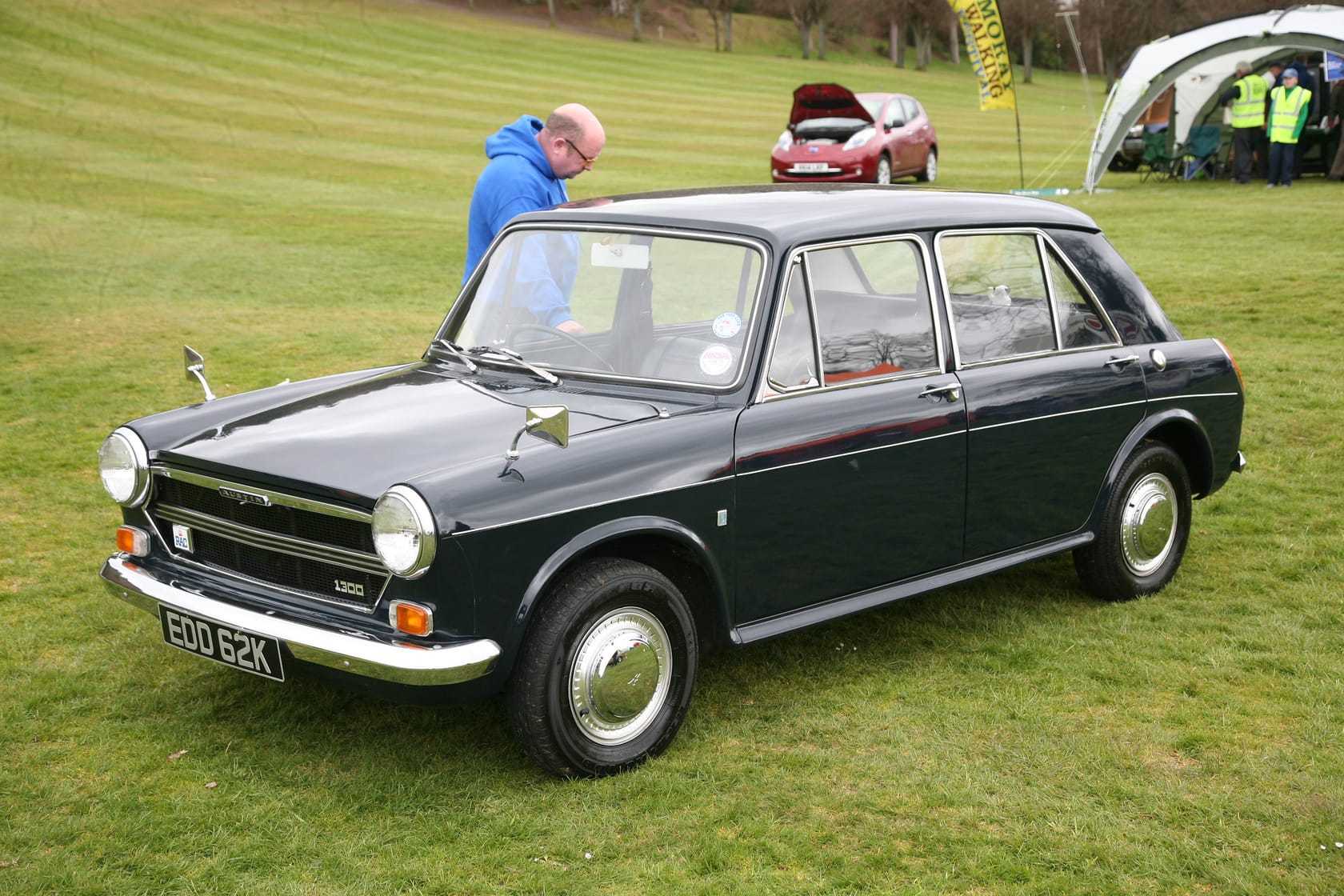
For eight of the eleven years between 1963 and 1974, the best-selling car in Britain was not the Cortina, the Mini or the Escort. It was this one: the BMC 1100 and 1300, known to its engineers as ADO16, sold under six badges, bought by over two million people, and then rusted so comprehensively off the road that the country simply forgot it. The Austin 1100 is the great vanished best-seller, and rediscovering one today is the closest classic motoring comes to archaeology.
Issigonis does it again
Three years after the Mini, Alec Issigonis applied the same revolution to the family car: transverse A-series engine, gearbox in the sump, front-wheel drive, a wheel at each corner, and a cabin that made rivals look wasteful. Pininfarina tidied the styling into crisp, airy elegance, and the Hydrolastic fluid suspension, making its debut, gave the little car a long-legged ride nothing in its class approached. Launched as the Morris 1100 in August 1962, it was an immediate, colossal success; the Issigonis story has no purer commercial triumph.

Every badge in the empire
BMC’s badge engineering reached full flower on this car. The Austin 1100 joined in 1963 for the other dealer network; MG’s twin-carburettor version added pace; the Riley Kestrel and Wolseley 1100 dressed it in walnut for the traditional buyer; and the Vanden Plas Princess 1100, finished in Kingsbury with leather and deep pile, topped the lot as Britain’s smallest limousine. Same body, same mechanicals, six grilles. The upmarket versions were minor sellers then but lead the survivor lists now, having been garaged and cherished while the plain cars worked themselves into the ground.

The 1300 and the GT
The 1275cc engine arrived for 1968, turning 1100s into 1300s across the range and giving the design the performance its chassis had always invited. The Austin 1300 became the definitive form, the twin-carb 1300 GT of 1969 added a vinyl roof, a rev counter and genuine 90 mph pace, and the Countryman and Traveller estates carried the family’s practical end. Mk2 and Mk3 revisions modernised trim and tail lights along the way. Production ran to 1974 at home, longer abroad: Spain, Italy, South Africa and Australia all built their own, and the Austin Allegro had the unenviable task of replacing it.

The 1100 abroad
Success travelled. Spain’s Authi and Italy’s Innocenti built their own versions, South Africa sold the restyled Austin Apache and Spain the Victoria, both wearing elegant Michelotti tails on the familiar centre section, and Australia assembled the family as the Morris 1100 through the decade. America received it as the Austin America, a name the auction record still uses. The diaspora matters to owners now because odd brightwork and rare variants surface constantly, and because it underlines how completely this design was BMC’s world car before the term existed.

What an 1100 is like to drive
The driving experience is the Mini’s party trick with the rough edges rounded off. The car corners with the same eager, flat, front-drive keenness, but the Hydrolastic ride smothers surfaces that send a Mini skittering, and the airy glasshouse makes town work effortless. The A-series thrums along happily at 60, the long-wheelbase stability shames some far newer cars, and the whole machine feels engineered as one idea rather than assembled from parts. Period road testers called it the best-riding small car in the world, and on the right B-road the claim still makes sense; passengers raised on modern crossovers step out asking what it was.

Buying an 1100 or 1300 today
Rust is the whole conversation. These cars dissolved from the sills, subframe mountings, floors, inner wings and the notorious rear radius-arm mounts, and the survivor you view has either been properly restored there or will need to be; repair sections exist but structural work is the real cost. Mechanically everything is shared BMC hardware, cheap and understood, with Hydrolastic units serviceable by the marque specialists. Trim is the hunt, especially Vanden Plas and GT fittings. The 1100 Club’s registers and expertise are the buyer’s best protection, and a documented, dry-stored car is worth every premium asked.

Values: the cheapest important car in Britain
The market has not yet caught up with the rarity. Usable cars at £2,500 to £4,000 and good ones at £4,000 to £7,000 make the 1100 and 1300 the cheapest genuinely important British classic there is, with only the GT, the MG and the Princess 1300 pushing toward five figures. That prices the full 1960s family-car experience, Hydrolastic ride and all, at less than a tired MGB, for a car with a stronger claim on the nation’s memory than almost anything in the 1960s catalogue.

More photos


1100/1300: the short history
- Aug 1962Launched as the Morris 1100: transverse A-series, front-wheel drive, Pininfarina-tidied styling and the debut of Hydrolastic suspension.
- 1963The Austin 1100 joins for the other dealer network, and the car begins eight years as Britain's best-seller.
- 1965MG, Riley Kestrel, Wolseley and Vanden Plas Princess versions complete six grilles on one body.
- 1968The 1275cc engine turns 1100s into 1300s across the range.
- 1969The twin-carburettor 1300 GT adds a vinyl roof, a rev counter and genuine 90 mph pace.
- 1974Home production ends and the Allegro takes on the unenviable replacement job; Spain, Italy, South Africa and Australia carry on abroad.
The 1100/1300 viewing checklist
Rust, the whole conversation
- Sills, subframe mountings and floors
- Inner wings and the notorious rear radius-arm mounts
- Repair sections exist, but structural work is the real cost
- A documented, dry-stored car is worth every premium asked
Mechanical
- Everything is shared BMC hardware, cheap and understood
- Hydrolastic units are serviceable by the marque specialists
- The A-series takes the Mini world's upgrades where wanted
- 1100 and 1300 engines swap easily, so confirm what is fitted
Badge and trim
- Upmarket versions lead the survivor lists, having been garaged while the plain cars worked
- Vanden Plas and GT trim are the scarce fittings
- The diaspora versions, Apache and Victoria included, surface with odd brightwork
- The 1100 Club's registers and expertise are the buyer's best protection
What the Austin & Morris 1100/1300 sells for at auction
In 2025 the median Austin & Morris 1100/1300 sold for £4,200 across 10 sales, 33% down on 2024. In real terms, typical Austin & Morris 1100/1300 prices were down about 40% over the five years to 2025, once inflation is accounted for.
| Variant | Sold | Typical range | Median |
|---|---|---|---|
| Princess 1300 | 46 | £2,697 - £7,090 | £4,298 |
| 1300 | 38 | £2,670 - £5,401 | £3,846 |
| 1100 | 31 | £2,050 - £5,252 | £3,815 |
Show the year-by-year mediansHide the year-by-year medians
| Year | Sold | Median | In 2025 money |
|---|---|---|---|
| 2026 (so far) | 10 | £5,925 | |
| 2025 | 10 | £4,200 | £4,200 |
| 2024 | 10 | £6,250 | £6,490 |
| 2023 | 21 | £3,871 | £4,154 |
| 2022 | 14 | £4,731 | £5,418 |
| 2021 | 11 | £3,432 | £4,244 |
| 2020 | 5 | £5,512 | £6,985 |
| 2019 | 6 | £3,014 | £3,858 |
| 2018 | 8 | £4,078 | £5,309 |
| 2017 | 6 | £3,370 | £4,489 |
| 2015 | 3 | £3,141 | £4,335 |
| 2013 | 4 | £3,638 | £5,112 |
- £1,280Princess 1300
- £5,750Princess 1300
- £6,100Princess 1300
- £4,6321100
- £12,6001300
Reasonable evidence. 115 recorded sales: enough for the range to mean something, though a few unusual cars can still move a single year's median. Based on 115 sold results from public classic car auctions (2006 to 10 August 2026). Sold prices, not asking prices, and not a valuation: condition, history and specification vary from car to car. Inflation-adjusted figures use the ONS CPIH index, in 2025 money.
Frequently asked questions
What is the difference between the Austin 1100 and Morris 1100?
Was the Austin 1100 a good car?
How many Austin and Morris 1100s are left?
What was the Vanden Plas Princess 1100 and 1300?
How much is an Austin 1100 or 1300 worth?
What is the most expensive Austin & Morris 1100/1300 ever sold at auction?
How often does an Austin & Morris 1100/1300 come up for sale?
Related across themes
More from Austin


Recently added

British car records: the smallest, the fastest, the dearest

Morgan 4/4: the longest-running car name in the world (1936–2018)

Selling a classic car privately: what the law asks of you, what it does not, and how not to get stung
