Hillman Imp: the rear-engined gamble that took on the Mini (1963–1976)
A rear-engined small saloon with an all-aluminium overhead-cam engine, built in a brand-new Scottish factory, the Imp was Rootes' brave answer to the Mini. A guide to why it was brilliant, why it struggled, the Sport, Stiletto and Chamois versions, its giant-killing motorsport record, and what an Imp costs today.
Built 1963–1976 39 recorded sales
At a glance
- Years
- 1963–1976
- Body styles
- Two-door saloon; coupe, estate and van derivatives
- Drivetrain
- Rear engine, rear-wheel drive
- Engines
- 875cc all-aluminium overhead-cam four (998cc in competition)
- Power
- 39 bhp standard; 51 bhp in Sport tune
- Trim levels
- Imp, Super Imp, Imp Sport, Californian; Singer Chamois, Sunbeam Imp Sport and Stiletto
- Production
- Around 440,000 including all derivatives
- Assembly
- Linwood, Scotland
- Designer
- Michael Parkes and Tim Fry (Rootes)
- Values
- Usable from around £3,000; good cars £5,000-£9,000; Sport and Stiletto beyond
- Engineering claim
- Among the first British mass-produced cars with an all-aluminium engine
- Party trick
- Opening rear window and folding rear seat, a hatchback in all but name
The models
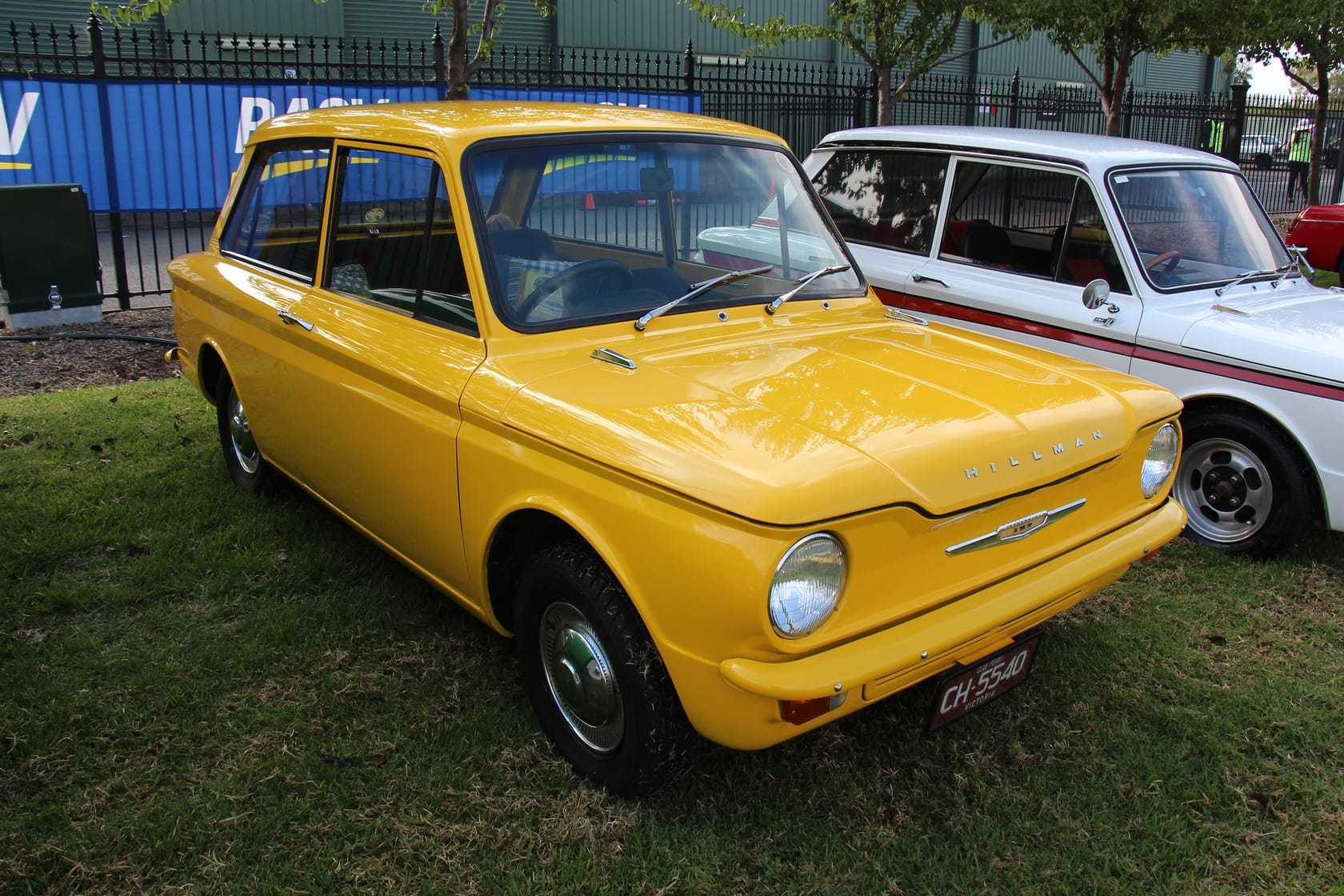
The Mini gets remembered as a triumph and the Hillman Imp as a failure, which is unfair on the car. The Imp was the Rootes Group’s answer to the Mini: smaller company, bolder engineering, worse luck. It carried its engine in the tail, made that engine from aluminium when rivals used cast iron, and gave its owners an opening rear window and folding rear seat that made it a hatchback in all but name, years early. What it never had was the time and money to be developed properly before launch.
The cleverest small car of 1963
Two young Rootes engineers, Michael Parkes and Tim Fry, designed the Imp around a jewel of an engine: an 875cc all-aluminium overhead-cam four, derived from a Coventry Climax fire-pump unit, canted over in the tail and driving the rear wheels. It revved like nothing else in the class, the gearchange was among the best of the decade, and the rear-engined layout gave flat cornering and quick, light steering. Against the Mini’s front-drive packaging the Imp offered its own kind of cleverness, and on the road it was, and is, the more entertaining car to drive hard.

Linwood and the launch that went wrong
The Imp’s real misfortune was industrial. Rootes needed a new factory, and government regional policy steered it to Linwood in Scotland, far from the group’s Midlands base and suppliers, with a workforce new to carmaking. The car was hurried into production in 1963 with immature details: a pneumatic throttle that baffled owners, early water-pump and head-gasket troubles, and an automatic choke that rarely behaved. The faults were engineered out within a few years, but small-car buyers value trust above all, and the damage to the Imp’s name, and to Rootes’ finances, was never repaired. The episode did as much as anything to hand the company to Chrysler.

Imp, Chamois, Sport and Stiletto
True to Rootes habit, one car wore many suits. Hillman sold the Imp, Super Imp and the sloping-roof Californian coupe; Singer dressed the same car as the plusher Chamois; Sunbeam supplied the performance versions, the twin-carburettor Imp Sport and the four-headlamp fastback Stiletto, the most sought-after of the family today. There was an estate, and Commer took the van. The 51 bhp Sport engine transforms the car and can be fitted to any of them, which many owners have done.

The giant-killer
Light weight, a free-revving engine and fine balance made the Imp a formidable competition car. Rosemary Smith won the Tulip Rally outright in 1965, works and private Imps collected class results through the decade, and Bill McGovern’s Sunbeam-badged car took the British Saloon Car Championship three years running from 1970 to 1972. That giant-killing record keeps Imps busy in historic racing, sprints and hillclimbs across Britain now, and it is a big part of the car’s enthusiast following.

Buying and running an Imp today
Two rules govern Imp ownership. The first is cooling: the aluminium engine tolerates no neglect, so evidence of a properly maintained system, a good radiator and sound head gasket matters more than anything else on the test drive. Ask when the system was last flushed and the head last checked, and walk away from any car that runs hot on the drive, because a cooked head is the classic Imp failure and the repair outweighs the car’s value. The second is the usual one, rust, in the sills, floors and front panel, with the front suspension mounts and the battery tray under the bonnet worth a torch as well. A sorted Imp is a simple, cheap car to keep, parts support through the clubs and specialists is strong, and the engine responds beautifully to sympathetic tuning.
On the road, a healthy Imp is a small delight. The unassisted steering is light and full of feel, the gearchange is famously sweet, and the engine spins eagerly to speeds that would worry an A-series, all of it carried on a chassis that corners flatter than a Mini and rides more gently too. The trade-offs are period ones: modest outright pace in standard tune, a gearing set for town rather than motorway, and a tail-heavy balance that rewards smoothness. Most owners fit the Sport engine or mild upgrades, and the car takes them gracefully.
Prices remain kind. Usable cars start around £3,000, good ones sit £5,000 to £9,000, and Sports and Stilettos carry a deserved premium, the best coupes now comfortably into five figures. For a 1960s classic with real engineering interest, the Imp is still one of the biggest bargains among the cars of the 1960s. Buy a sorted one, join the club run, and enjoy owning the clever car history got wrong.

More photos


Key dates for the Imp
- 1963Launched from the new Linwood factory in Scotland: an 875cc all-aluminium overhead-cam four in the tail, with an opening rear window and folding seat, a hatchback in all but name.
- 1965Rosemary Smith wins the Tulip Rally outright; the early water-pump, head-gasket and pneumatic-throttle troubles are engineered out, too late for the reputation.
- 1966The Sunbeam Imp Sport brings twin carburettors and 51 bhp; Singer sells the plusher Chamois.
- 1967The four-headlamp fastback Sunbeam Stiletto arrives, the most sought-after of the family; the Californian coupe serves Hillman.
- 1970Bill McGovern's Sunbeam-badged Imp begins three straight British Saloon Car Championship wins.
- 1976Production ends at around 440,000 including all derivatives.
Before you buy an Imp
Cooling, the first rule
- Evidence of a properly maintained system, a good radiator and a sound head gasket matters more than anything
- Ask when the system was last flushed and the head last checked
- Walk away from any car that runs hot on the test drive
- A cooked head is the classic Imp failure, and the repair outweighs the car's value
Rust, the second rule
- Sills, floors and the front panel
- Front suspension mounts
- The battery tray under the bonnet, with a torch
- A sorted Imp is a simple, cheap car to keep thereafter
Version and tuning
- The 51 bhp Sport engine transforms the car and fits any of them, which many owners have done
- The Stiletto leads the family's values, with the Imp Sport behind it
- Singer Chamois trim is the plush variant and its own small hunt
- The engine responds beautifully to sympathetic tuning, and the clubs know how
What the Hillman Imp sells for at auction
| Variant | Sold | Typical range | Median |
|---|---|---|---|
| Imp | 15 | £3,000 - £8,387 | £5,376 |
| Super Imp | 15 | £3,400 - £8,091 | £4,704 |
| Imp Californian | 6 | £8,669 - £15,248 | £11,975 |
Show the year-by-year mediansHide the year-by-year medians
| Year | Sold | Median | In 2025 money |
|---|---|---|---|
| 2025 | 7 | £7,182 | £7,182 |
| 2024 | 4 | £5,277 | £5,480 |
| 2023 | 4 | £2,895 | £3,107 |
| 2021 | 6 | £4,503 | £5,568 |
| 2016 | 3 | £5,962 | £8,146 |
- £4,592Imp
- £6,325Super Imp
- £2,237Imp
- £6,500Imp
- £11,250Super Imp
Thin evidence. Only 39 recorded sales: read the figures as a sketch of the market, not a price. Based on 39 sold results from public classic car auctions (2005 to 10 August 2026). Sold prices, not asking prices, and not a valuation: condition, history and specification vary from car to car. Inflation-adjusted figures use the ONS CPIH index, in 2025 money.
Frequently asked questions
Why did the Hillman Imp fail?
Is the engine in a Hillman Imp really made of aluminium?
What is the difference between an Imp, a Chamois and a Stiletto?
Was the Hillman Imp any good in motorsport?
How much does a Hillman Imp cost to buy?
What is the most expensive Hillman Imp ever sold at auction?
How often does a Hillman Imp come up for sale?
Related across themes
More from Rootes Group


Recently added

British car records: the smallest, the fastest, the dearest

Morgan 4/4: the longest-running car name in the world (1936–2018)

Selling a classic car privately: what the law asks of you, what it does not, and how not to get stung
