Sunbeam Rapier: two shapes, five Series and a rally-winning streak (1955–1976)
Two decades of sporting saloon-coupe, first as the rally-winning two-door Series cars of 1955 to 1967, then as the sleek fastback of 1967 to 1976 with the Holbay-tuned H120 at its head. A guide to both generations, the competition record, what to look for, and what a Rapier costs today.
Built 1955–1976 75 recorded sales
At a glance
- Years
- 1955–1967 (Series); 1967–1976 (fastback)
- Body styles
- Two-door sports saloon and convertible; two-door fastback coupe
- Drivetrain
- Front engine, rear-wheel drive
- Engines
- 1390cc to 1725cc overhead-valve fours
- Power
- Around 62 bhp to 105 bhp (H120)
- Trim levels
- Series I-V; fastback Rapier, H120; Alpine fastback (economy version)
- Production
- Around 69,000 Series cars; around 46,000 fastbacks
- Assembly
- Ryton-on-Dunsmore, England
- Designer
- Audax styling with the Raymond Loewy studio; fastback by Roy Axe (Rootes)
- Values
- Usable from around £4,000; good Series cars £8,000-£14,000; convertibles and H120s beyond
- Competition record
- Outright RAC Rally winner in 1958; consistent Monte Carlo class contender
- The H120
- Holbay-tuned 1725 with twin Webers, the fastest Rootes four
The models
Twenty-one years, two entirely different shapes and one constant idea: the Sunbeam Rapier was the Rootes Group’s sporting car for the family man, faster and better dressed than the Hillmans it grew from, and for a golden stretch of the late 1950s it was a rally winner you could buy in a high-street showroom.
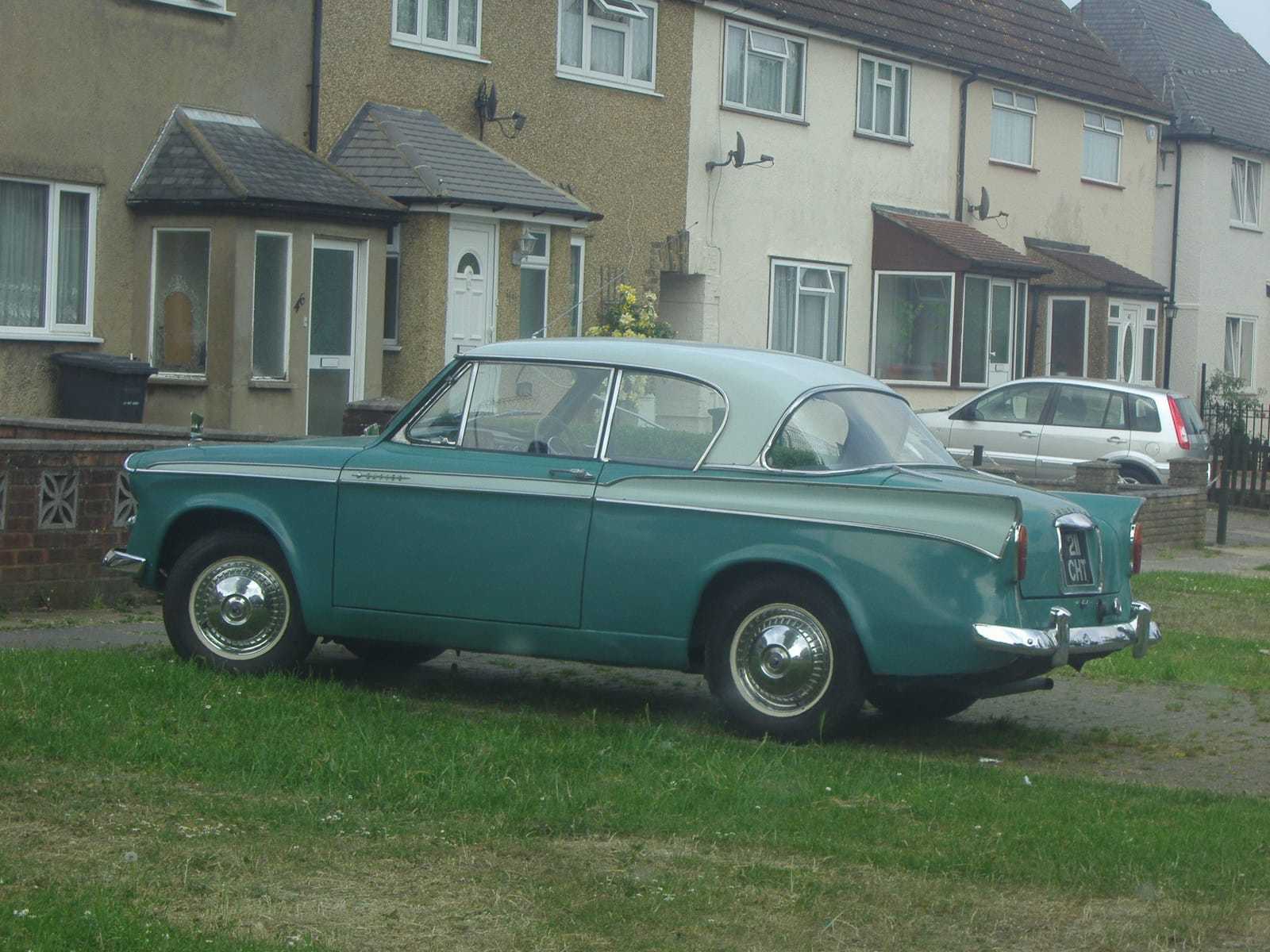
The Series cars: two-tone and rally plates
The first Rapier of 1955 wore the group’s new Audax styling, shaped with Raymond Loewy’s studio, as a crisp two-door sports saloon, usually two-tone, with a convertible joining early on. Series by Series, Rootes gave it more: the Series II brought the 1494cc engine and a proper floor change, the Series III and the overdrive-equipped Series IIIA sharpened the styling and brakes, and engines grew again through 1592cc to the 1725cc of the Series V, power roughly doubling over the run while the same basic elegance carried through to 1967. Underneath sat toughened Hillman Minx engineering, which was exactly the point: the Rapier was the sharp suit on sensible shoes.
Its rally record made the name. Works Rapiers were front-runners in British and European rallying, Peter Harper took outright victory on the 1958 RAC Rally, and the model was a fixture in the Monte Carlo results through the turn of the decade. Few cars of the era wore their competition history so visibly in the showroom.

The fastback: Roy Axe’s American line
In 1967 the Rapier name moved to an altogether different car: a long, low, pillarless fastback coupe styled by Roy Axe on the group’s modern Arrow platform, the same underpinnings as the Hillman Hunter. Its sweeping tail and hardtop glasshouse gave it real transatlantic glamour, and it stayed in production, essentially unchanged, until 1976, outliving every other Sunbeam and the group’s independence itself. A plainer, cheaper version confusingly revived the Alpine name, while the range was topped by something much more interesting.

The H120: the fastest Rootes four
The H120 of 1968 was the fastback with its jacket off: a 1725cc engine tuned by the racing-engine builder Holbay with twin Weber carburettors and around 105 bhp, a close-ratio gearbox, wider wheels, stripes and a subtle boot spoiler. It pushed the Rapier beyond 100 mph and gave the old sporting badge one last genuine performance car. H120s were built in modest numbers, and finding an unmolested one is the collector’s challenge of the range.

One floorpan, many badges
Understanding a Rapier means understanding the Rootes system. The Series cars sit on the strengthened bones of the contemporary Minx, with more power, closer gearing, better trim and overdrive on most cars, and their badge-cousins include the Singer Gazelle and the Sunbeam Alpine roadster, which borrowed heavily from the same parts shelf. The fastback sits on the Arrow platform under the Hillman Hunter and the last Humber Sceptre, the plush sibling of the family.
For an owner this is nothing but good news. Service parts, engines, gearboxes and much of the running gear are shared with cars built in the hundreds of thousands, so mechanical bills stay small and specialist knowledge is easy to find. What is not shared is the jewellery: the Rapier-only brightwork, badges, dashboards and pillarless door glass that make the car what it is, which is why a complete car matters more than a mechanically perfect one.
Buying a Sunbeam Rapier today
Both generations follow the same rules. Mechanically they are simple, tough and cheap, with parts shared across the Rootes range; structurally they rust in the sills, floors, wheelarches and spring hangers, and the two-tone brightwork, pillarless door glass and model-specific trim of the Series cars are the genuinely scarce commodities. Convertibles need extra care on structural integrity, and an H120 needs its provenance checked, since stripes and a spoiler are easily added.
On inspection, work from the ground up. Check the sills and jacking points honestly, lift the carpets for floor repairs, and examine the rear spring hangers, because these decide whether a cheap Rapier is a bargain or a liability. Then confirm the trim is complete: bumpers, grilles, side flashes and interior fittings differ between Series and are the hardest things to source. Overdrive should engage promptly; a working system is a real plus on any Series car.
Values are gentle for what the car is. Usable Series saloons start around £4,000, good ones run £8,000 to £14,000, convertibles go well beyond, and fastbacks remain the bargain of the family, only the H120 breaking clear. Values have moved little in a decade, so buy on condition and use the car, because appreciation will not pay for a restoration here. For a car with an outright RAC Rally win in its family album, that looks like value among the cars of the 1950s and 1960s. The Rapier remains rallying royalty at family-saloon money, and the market has not noticed yet.

More photos


Rapier: what changed and when
- 1955The first Rapier arrives in the group's new Loewy-studio Audax styling, a two-tone sports saloon on toughened Minx bones.
- 1958Peter Harper takes outright victory on the RAC Rally, and the Rapier becomes a Monte Carlo fixture.
- 1961Series III and IIIA sharpen the styling and brakes, with overdrive; engines grow through 1,592cc.
- 1965The Series V brings the 1,725cc engine, power roughly doubled over the run.
- 1967The name moves to Roy Axe's pillarless fastback on the Arrow platform, with transatlantic glamour.
- 1968The H120 tops the range: Holbay-tuned 1725, twin Webers, around 105 bhp and past 100 mph.
- 1976The fastback bows out essentially unchanged, having outlived every other Sunbeam and the group's independence.
What to check on a Rapier
Structure
- Sills, floors, wheelarches and spring hangers on both generations
- The pillarless fastback's door glass and seals deserve their own check
- Convertible Series cars want the structure examined harder still
- Mechanical repair is cheap, so the shell decides the purchase
The jewellery
- Rapier-only brightwork, badges and dashboards are what make the car, and the hunt
- Two-tone paint compounds the brightwork problem
- A complete car matters more than a mechanically perfect one
- H120 stripes, wheels and boot spoiler should be the genuine articles
Mechanical and version
- Overdrive should engage promptly; a working system is a real plus on any Series car
- Service parts are shared across the Rootes range and stay cheap
- The H120's Holbay engine and close-ratio box need verifying against the records
- Fastbacks are the bargain of the family; convertibles and H120s carry the premiums
What the Sunbeam Rapier sells for at auction
In real terms, typical Sunbeam Rapier prices were down about 47% over the five years to 2025, once inflation is accounted for.
| Variant | Sold | Typical range | Median |
|---|---|---|---|
| Rapier | 43 | £4,692 - £8,393 | £6,666 |
| Rapier Series IV | 9 | £3,472 - £7,088 | £5,292 |
| Rapier Series III | 6 | £9,206 - £18,129 | £12,016 |
| Rapier Series V | 5 | £4,050 - £7,112 | £4,838 |
| Rapier Series II | 5 | £15,589 - £18,562 | £16,126 |
| Rapier Series IIIA | 5 | £3,038 - £11,872 | £6,691 |
Show the year-by-year mediansHide the year-by-year medians
| Year | Sold | Median | In 2025 money |
|---|---|---|---|
| 2026 (so far) | 5 | £5,292 | |
| 2025 | 11 | £8,000 | £8,000 |
| 2024 | 5 | £4,838 | £5,024 |
| 2023 | 17 | £6,666 | £7,153 |
| 2022 | 5 | £8,400 | £9,620 |
| 2021 | 8 | £10,452 | £12,925 |
| 2020 | 4 | £11,926 | £15,113 |
| 2018 | 5 | £10,350 | £13,475 |
| 2017 | 3 | £3,600 | £4,795 |
| 2010 | 3 | £10,580 | £16,205 |
- £2,700Rapier Series V
- £14,062Rapier Series IIIA
- £3,300Rapier Series IV
- £7,112Rapier Series V
- £5,292Rapier Series IV
Reasonable evidence. 75 recorded sales: enough for the range to mean something, though a few unusual cars can still move a single year's median. Based on 75 sold results from public classic car auctions (2004 to 10 August 2026). Sold prices, not asking prices, and not a valuation: condition, history and specification vary from car to car. Inflation-adjusted figures use the ONS CPIH index, in 2025 money.
Frequently asked questions
Was the Sunbeam Rapier a successful rally car?
What is the difference between the Series Rapier and the fastback?
What is a Sunbeam Rapier H120?
Which cars share their basis with the Rapier?
How much does a Sunbeam Rapier cost?
What is the most expensive Sunbeam Rapier ever sold at auction?
How often does a Sunbeam Rapier come up for sale?
Related across themes
More from Rootes Group


Recently added

British car records: the smallest, the fastest, the dearest

Morgan 4/4: the longest-running car name in the world (1936–2018)

Selling a classic car privately: what the law asks of you, what it does not, and how not to get stung
