Triumph TR7 and TR8: the wedge that ended the line (1975–1981)
The Triumph TR7 dropped the TR formula for a sharp Harris Mann wedge and became the best-selling TR of all, and the Rover-V8 TR8 gave the line its farewell muscle. A guide to coupe and convertible, the factories and the quality story, the rare TR8, and what to check before buying one.
Built 1975–1981 309 recorded sales
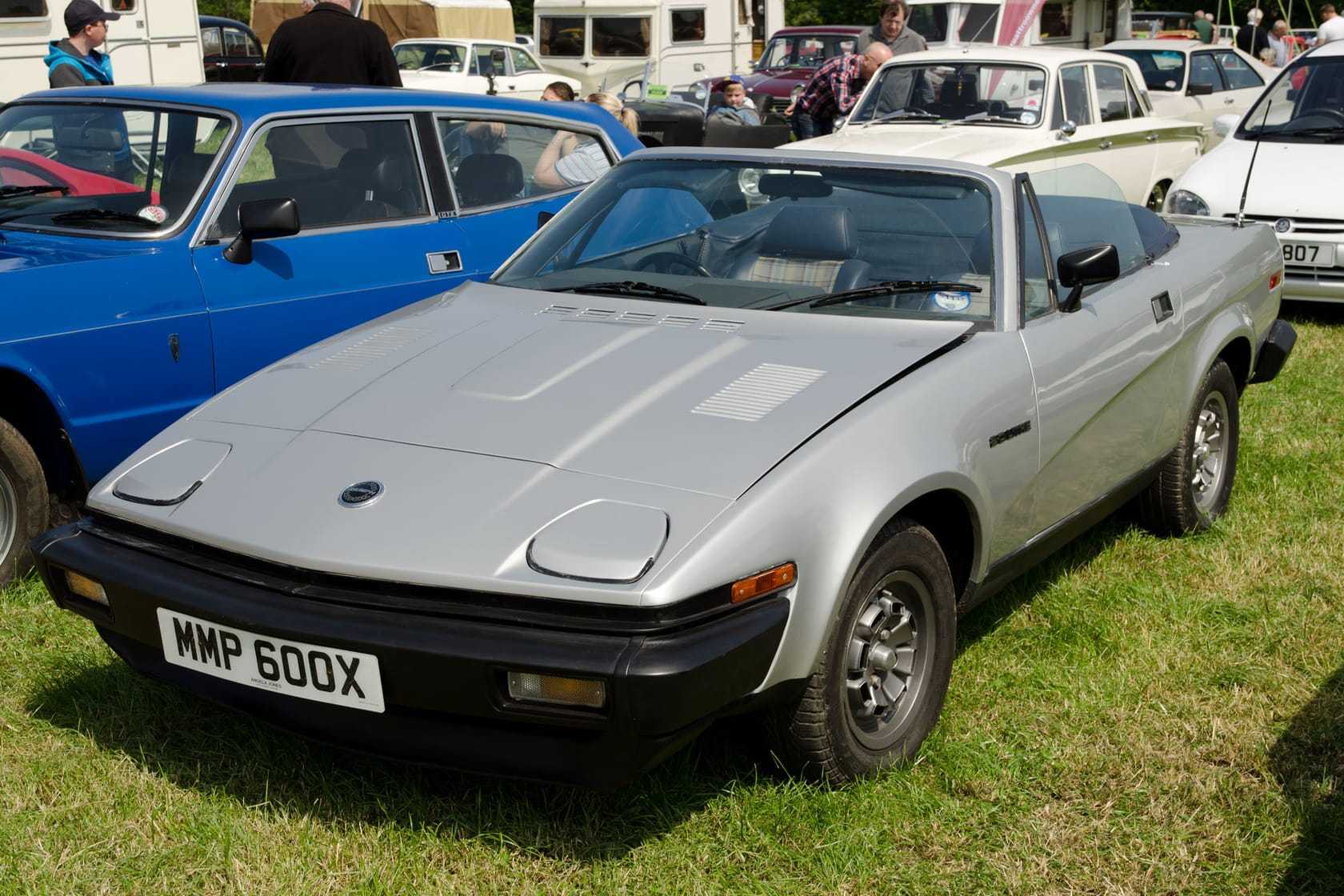
At a glance
- Years
- 1975–1981
- Body styles
- Two-seat fixed-head coupe; convertible from 1979
- Drivetrain
- Front engine, rear-wheel drive
- Engines
- 1998cc slant-four (TR7); 3528cc Rover V8 (TR8)
- Power
- 105 bhp (TR7); around 133-137 bhp (TR8)
- Top speed
- Around 110 mph (TR7); 120 mph (TR8)
- Trim levels
- TR7 coupe and convertible; TR8 (mostly North American); works rally V8s
- Production
- Around 112,000 TR7s; around 2,750 TR8s
- Assembly
- Speke, Liverpool; Canley, Coventry; Solihull
- Designer
- Harris Mann
- Values
- TR7s usable from around £4,000; good cars £6,000-£10,000; genuine TR8s £15,000-£30,000
- The volume
- The best-selling TR of them all, at around 112,000 cars
- The rarity
- Around 2,750 factory TR8s, nearly all left-hand drive
The models
The last chapter of the TR story sold more copies than any before it. The Triumph TR7 of 1975 threw away the separate-chassis roadster formula for a sharp Harris Mann wedge, survived three factories and a thousand jokes, and found around 112,000 buyers; the Rover-V8 TR8 gave the line its parting shot. Half a century on, the wedge is the affordable TR, and the one whose reputation least matches its reality.
The shape of things to come
British Leyland aimed the TR7 squarely at America, and expected US rollover rules shaped it: a fixed-head coupe first, with a dramatic rising swage line, pop-up headlamps and not a curve Michelotti would recognise. Under the wedge sat rational hardware, the Dolomite-derived two-litre slant-four, a five-speed option from 1976, and suspension tuned for the long American mile. Purists mourned the TR6’s hair on its chest; buyers, especially American ones, made the newcomer the best-selling TR ever.

Coupe, convertible and the quality story
The TR7’s troubles were industrial before they were mechanical. Built first at strike-plagued Speke, the model carried early quality scars that moved with the headlines; the 1978 transfer to Canley and 1980 move to Solihull improved the cars steadily, and the 1979 convertible, stiffened and resolved, was the version the design had always implied. The drop-top promptly outsold the coupe and leads the market today. Forty years of selective survival have done the rest: the wedge you buy now is whatever its owners made it, factory of origin notwithstanding.

TR8: the eight the line deserved
Rover’s 3.5-litre aluminium V8 slotted into the wedge as if drawn for it, and the factory TR8 of 1978–81 finally gave the shape the muscle its stance promised: 120 mph, a proper soundtrack, and effortless torque. Nearly all of the roughly 2,750 factory cars went to North America in left-hand drive, which makes a genuine TR8 rare everywhere and a unicorn in right-hand drive. The works rally programme ran V8 wedges with genuine success, Tony Pond’s drives entering Triumph legend, and the engine’s shared ancestry with the Rover-powered classics keeps parts plentiful.

The wedge in competition
The TR7’s competition record answers most jibes. The works rally programme ran 16-valve TR7s and then the thunderous TR7 V8s, Tony Pond and Per Eklund hustling them to international podiums and home-rally wins through 1978–80, the V8 cars effectively TR8s in all but paperwork. Across the Atlantic, Bob Tullius’s Group 44 team raced TR7s and TR8s to SCCA national championships, giving the wedge genuine American silverware. Historic rallying keeps the V8 cars in anger to this day, and their surviving works machines trade as blue-riband Triumphs, a fact worth remembering when the shape gets teased.

What a wedge is like to drive
Expect grand touring, not vintage drama. The TR7 rides comfortably, steers accurately, and cruises at modern pace with a civility no earlier TR approaches; the slant-four is willing rather than thrilling, which is why the V8’s transformation defines the TR8’s premium. The cabin is wide, the boot real, and long journeys easy, the car’s American brief showing at every mile. Enthusiasts who arrive expecting a lesser TR6 leave having met a different, gentler car, and often a more usable one; our which TR to buy guide sets the whole family side by side.

Buying a TR7 or TR8 today
Rust first: sills, arches, screen surrounds, boot floors and the bonnet’s leading edge all go, and structural repair outruns low values quickly, so condition beats everything. The slant-four asks for cooling-system health, head-gasket history and evidence of oil changes; five-speed cars are preferred. On any TR8, provenance is the purchase: verify factory records before paying V8 premiums, and price honest conversions as converted TR7s. Trim and electrics are the usual 1970s Leyland hunts, with tartan seat fabric the celebrated period flourish worth preserving at any cost. Club support, shared with the whole TR world, is excellent, and wedge-specific specialists keep every mechanical part in circulation.

Where the wedge sits in the market
TR7 money remains the gentlest in the TR family: a sound four-cylinder car sits in the middle thousands and a genuine TR8 at well over twice that, on its factory build records rather than its engine. The full record, 309 recorded sales with the coupe and convertible closer together than the folklore claims and five flat years that have quietly cost the wedge a third of its real value, is on the page covering what a TR7 and TR8 sell for. That pricing makes the wedge the working entry to TR ownership and, increasingly, a period design statement in its own right; the 1970s look better on it every year. The line that began with side-screens in 1953 ended here in 1981, and the ending is far better company than its jokes. Buy a sound Triumph TR7 now, drive it as the grand tourer it always was, and let the market’s slow rehabilitation do the rest.

More photos


TR7 / TR8: the short history
- 1975Launched as a fixed-head coupe aimed at America, shaped by expected US rollover rules: a rising swage line, pop-up headlamps and the Dolomite-derived two-litre slant-four.
- 1976A five-speed gearbox becomes an option.
- 1978Production moves from strike-plagued Speke to Canley, and the cars improve steadily; the works rally programme runs 16-valve and then V8 wedges.
- 1979The stiffened convertible arrives, the version the design had always implied, and promptly outsells the coupe.
- 1980Production moves again to Solihull; Tony Pond and Per Eklund take the V8 cars to international podiums and home-rally wins.
- 1981Production ends at around 112,000 TR7s and 2,750 TR8s, closing the line that began with side-screens in 1953.
TR7 / TR8: what to check before you buy
TR8 provenance
- Verify factory build records before paying any V8 premium
- Nearly all of the roughly 2,750 factory cars went to North America in left-hand drive
- Price an honest conversion as a converted TR7, not as a TR8
- Surviving works rally cars trade as blue-riband Triumphs and need their own paperwork
Build and body
- Speke, Canley and Solihull cars differ in reputation, though forty years of selective survival matter more
- The convertible was stiffened and resolved, and leads the market
- Trim and electrics are the usual 1970s Leyland hunts
- Tartan seat fabric is the celebrated period flourish and worth preserving
Mechanical
- The Dolomite-derived slant-four is the volume engine and well understood
- The Rover V8 shares parts with a whole family of British classics
- The five-speed option from 1976 is worth seeking
- Wedge-specific specialists keep every mechanical part in circulation
What the Triumph TR7 & TR8 sells for at auction
In 2025 the median Triumph TR7 & TR8 sold for £6,227 across 37 sales, much where it was in 2024. In real terms, typical Triumph TR7 & TR8 prices were down about 57% over the five years to 2025, once inflation is accounted for.
| Variant | Sold | Typical range | Median |
|---|---|---|---|
| TR7 Convertible | 113 | £3,000 - £6,496 | £4,860 |
| TR7 | 105 | £3,565 - £8,700 | £5,300 |
| TR8 | 91 | £8,788 - £16,234 | £12,508 |
Show the year-by-year mediansHide the year-by-year medians
| Year | Sold | Median | In 2025 money |
|---|---|---|---|
| 2026 (so far) | 25 | £7,100 | |
| 2025 | 37 | £6,227 | £6,227 |
| 2024 | 51 | £6,300 | £6,542 |
| 2023 | 49 | £6,259 | £6,717 |
| 2022 | 34 | £7,748 | £8,873 |
| 2021 | 34 | £7,280 | £9,002 |
| 2020 | 17 | £11,350 | £14,383 |
| 2019 | 10 | £6,746 | £8,635 |
| 2018 | 10 | £3,879 | £5,050 |
| 2017 | 14 | £5,902 | £7,861 |
| 2016 | 10 | £3,927 | £5,366 |
| 2011 | 4 | £3,392 | £5,002 |
- £4,000TR7
- £1,800TR7
- £5,707TR7 Convertible
- £2,760TR7
- £12,800TR7
Strong evidence. 309 recorded sales and a dozen or more a year: the median and the range are well founded. Based on 309 sold results from public classic car auctions (2005 to 10 August 2026). Sold prices, not asking prices, and not a valuation: condition, history and specification vary from car to car. Inflation-adjusted figures use the ONS CPIH index, in 2025 money.
Frequently asked questions
Why does the Triumph TR7 look so different from earlier TRs?
What is the difference between the TR7 and TR8?
Was the Triumph TR7 really that badly built?
Should I buy a TR7 coupe or convertible?
How much does a Triumph TR7 & TR8 sell for?
What is the most expensive Triumph TR7 & TR8 ever sold at auction?
How often does a Triumph TR7 & TR8 come up for sale?
Related across themes
More from Triumph

Triumph Acclaim: the Honda handshake that ended a marque (1981–1984)

Triumph Vitesse: the Herald with a six-cylinder heart (1962–1971)

Standard Vanguard: one car for the whole world, and the engine that powered everything (1947–1963)

Triumph Roadster: dickey seats, Bergerac and the last of a breed (1946–1949)
Recently added

British car records: the smallest, the fastest, the dearest

Morgan 4/4: the longest-running car name in the world (1936–2018)

Selling a classic car privately: what the law asks of you, what it does not, and how not to get stung
